

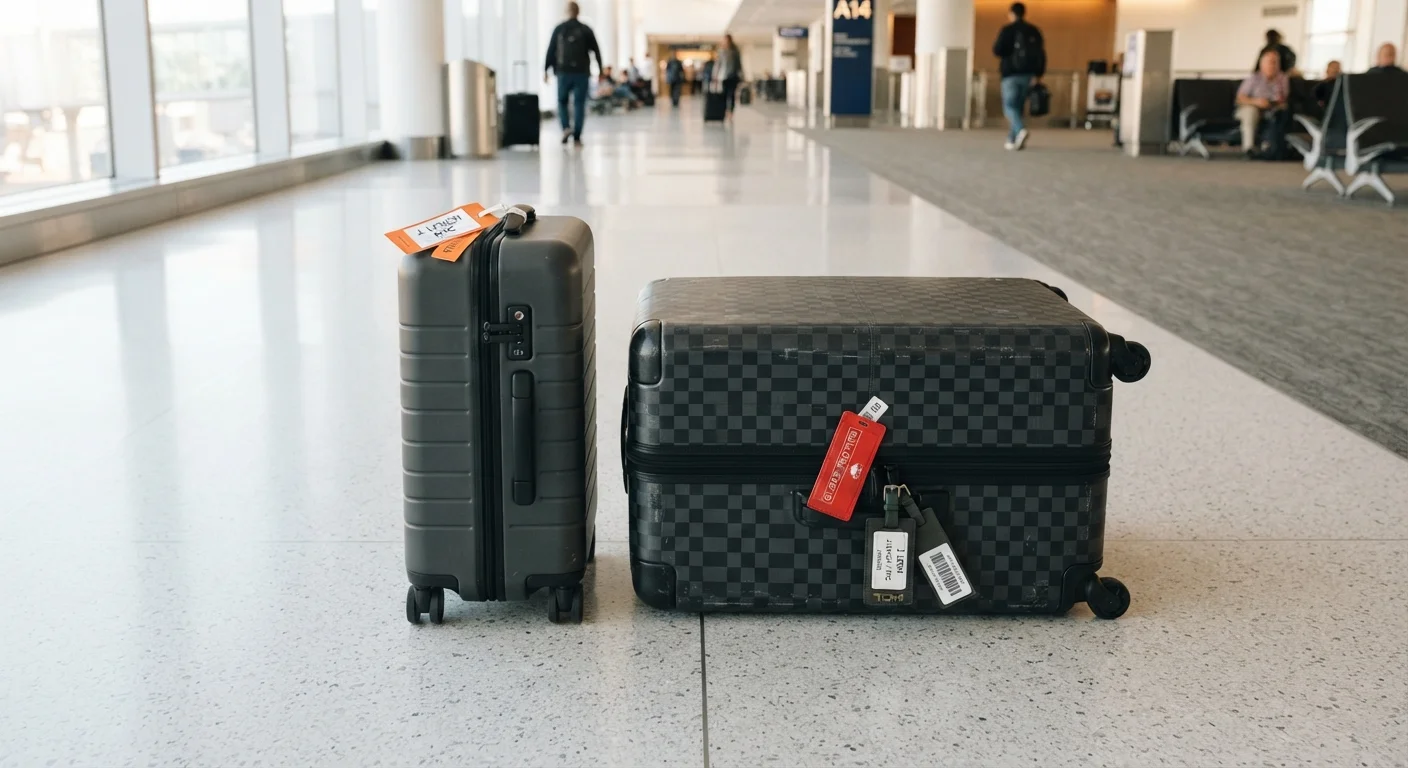
Key Takeaways
Option A
Carry-On Luggage
The nimble, fee-free option for travelers who move fast.
Best for: Short trips, frequent flyers, and anyone who wants to skip the baggage claim entirely.
Option B
Checked Luggage
The spacious, versatile choice for longer or more complex journeys.
Best for: Extended trips, family travel, and situations requiring specialty gear or regulated liquids.
If you're taking a weekend trip or short domestic flight
Carry-On Luggage
A well-packed carry-on easily handles two to three days of clothing and eliminates fees and baggage claim delays.
If you're traveling internationally for two or more weeks
Checked Luggage
Longer trips demand more clothing variety, full-size toiletries, and flexibility that only a checked bag can realistically provide.
If you're traveling with young children or specialty gear
Checked Luggage
Car seats, strollers, sports equipment, and bulky baby supplies make a checked bag the practical choice for family travelers.
If you're a budget-conscious traveler flying a low-cost carrier
Carry-On Luggage
Budget airlines often charge heavily for checked bags; a carry-on keeps your total trip cost significantly lower.
What You're Really Deciding
Choosing between a carry-on and checked luggage isn't just about bag size - it shapes your entire airport experience, your budget, and even what you can bring. For beginner travelers especially, it's easy to assume one approach is always better. The reality is that the right choice depends on your trip, your tolerance for inconvenience, and how you want to spend your time and money.
Part of thinking through this decision connects to a broader packing philosophy. Our guide on overpacking vs. underpacking explores how both extremes create problems and how to find a middle ground that actually works on the road.
| Criterion | Carry-On | Checked Luggage |
|---|---|---|
| Typical fee (domestic U.S.) | Usually free | $30-$40+ each way |
| Packing capacity | Limited (approx. 40-45L) | Generous (60-100L+) |
| Liquids allowed | 3.4 oz containers only | Full-size containers permitted |
| Airport exit time | Walk straight out | 20-40 min baggage claim wait |
| Risk of loss or delay | None - stays with you | Small but real risk |
| Best trip length | 1-5 nights | 6+ nights or complex itineraries |
| Family/gear travel | Challenging | Well suited |
The Case for Carry-On
The biggest advantage of flying carry-on only is speed. You board, you deplane, and you walk straight out of the airport - no standing at a baggage carousel for 20-40 minutes, and no checked bag fee (typically $30-$40 each way on most major U.S. carriers). Over several trips a year, that adds up fast.
Carry-on travel also removes the anxiety of lost or delayed luggage. If your bag is in the overhead bin, it arrives when you do. And for trips of three to five days, a standard carry-on (usually up to 22 x 14 x 9 inches on most domestic carriers) is genuinely enough space for most travelers who pack efficiently.
That said, there's one firm limit you can't work around: the TSA's 3-1-1 rule requires that all liquids, aerosols, and gels in carry-ons be in containers of 3.4 oz (100ml) or less, all fitting in one quart-sized clear bag. Full-size shampoos, sunscreen bottles, and most toiletry kits won't make the cut. For practical tips on managing this, see our piece on packing light without sacrificing what you actually need.
The Case for Checked Luggage
Checked bags open up a fundamentally different kind of trip. You can pack full-size toiletries, bring a wider clothing rotation, and include items that aren't allowed in the cabin - think scissors, certain tools, or larger quantities of liquids. For trips lasting more than a week, or destinations with varied climates, that extra space is genuinely valuable.
Checked luggage also makes sense for travelers bringing sports or recreational equipment, or for families traveling with young children whose gear (strollers, car seats, portable cribs) simply won't fit overhead. Airlines have specific policies on oversized items - always verify directly with your carrier before travel.
The trade-off is real, though. According to the U.S. Department of Transportation's Air Travel Consumer Report, U.S. airlines mishandled approximately 7 bags per 1,000 passengers in 2023. That's a small but non-trivial risk, particularly on itineraries with tight connections. Checking a bag also adds time and a fee on each leg of your journey.
~7 per 1,000
Bags mishandled per 1,000 passengers
According to the U.S. Department of Transportation's Air Travel Consumer Report for 2023.
$30-$40
Typical checked bag fee per direction
Fees vary by airline, fare class, and loyalty status; always verify with your carrier before booking.
3.4 oz
Maximum liquid container size for carry-on
TSA's 3-1-1 rule limits all carry-on liquids, aerosols, and gels to containers of 3.4 oz (100ml) or less.
Making the Call for Your Specific Trip
A few practical questions help clarify the decision quickly. How many nights are you away? If it's fewer than five, carry-on is almost always workable. Are you connecting through multiple airports? A carry-on eliminates the risk of your bag missing a tight connection. Are you doing any outdoor activities or attending formal events that require specific footwear or attire? That extra bulk often pushes travelers toward checking a bag.
It's also worth thinking about the type of travel experience you're building. A carry-on-only approach pairs well with flexible, spontaneous itineraries - the kind explored in our look at solo vs. group travel. Group trips or package holidays often involve more planned luggage handling, which can make a checked bag easier to manage.
Finally, keep your documents organized regardless of which bag approach you choose. Whether you go digital or print hard copies, preparation matters - our guide on offline vs. online travel documents covers when each format works and when it fails.