
Key Takeaways
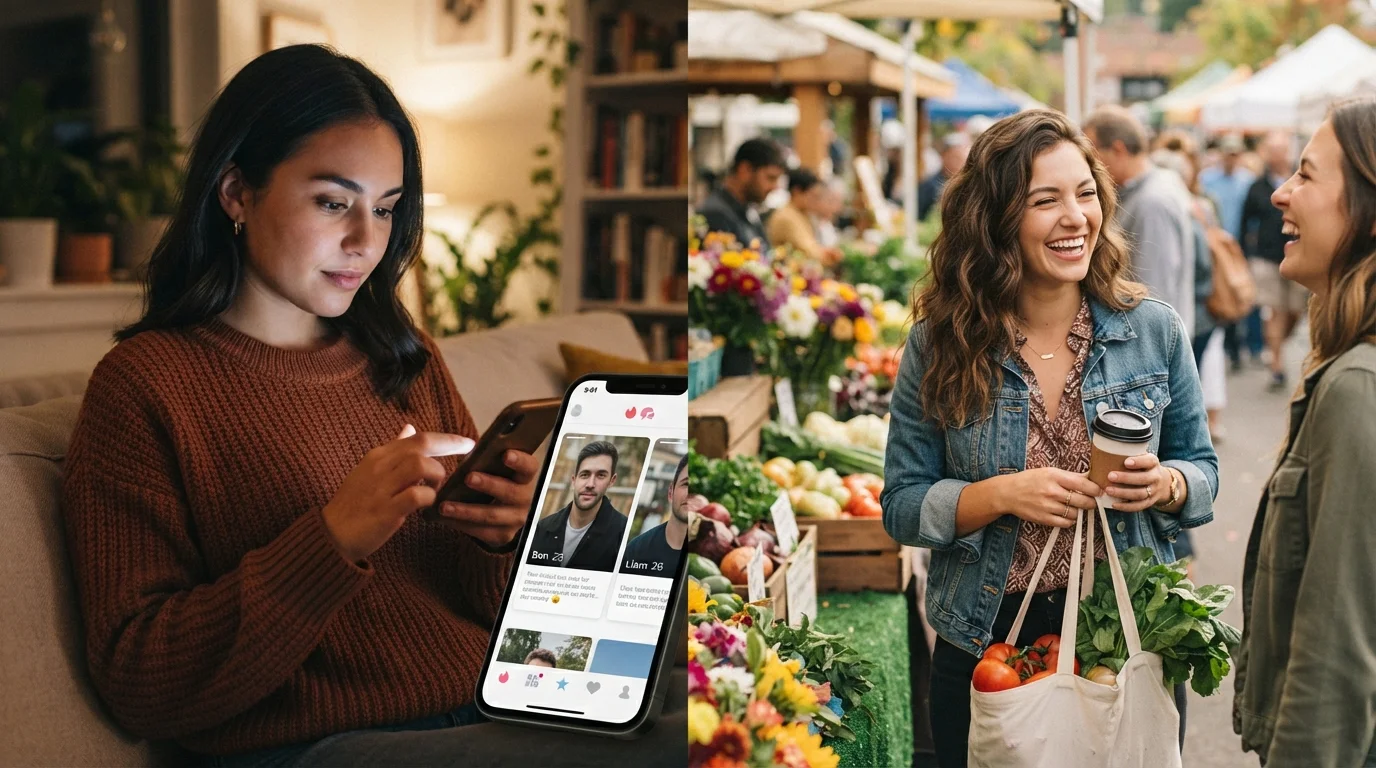
Option A
App-Based Dating
The structured, scalable approach to meeting potential partners.
Best for: People who want to expand their dating pool deliberately and filter for compatibility before investing time in person.
Option B
Meeting People Organically
The spontaneous, context-rich path to human connection.
Best for: People who thrive on natural chemistry and want shared real-world experiences to anchor early attraction.
If you have a busy schedule and limited social overlap with single people
App-Based Dating
Apps let you connect with potential partners outside your existing social circles on your own schedule, without needing to be in the right place at the right time.
If you find digital communication flat and chemistry hard to gauge through a screen
Meeting People Organically
In-person context gives you immediate access to body language, tone, and shared energy - signals that matter enormously for early attraction.
If you're re-entering dating after a long relationship or move to a new city
App-Based Dating
Apps provide a structured, low-pressure entry point when your existing social network doesn't yet include many single people.
If you're experiencing swiping fatigue or emotional burnout from online dating
Meeting People Organically
Stepping away from apps and investing in community activities can restore your sense of genuine connection and reduce the pressure of constant evaluation.
If you want to maximise your chances without limiting yourself to one approach
App-Based Dating
Using apps as one tool among many - alongside social events, classes, and community spaces - tends to produce the widest and most varied opportunities for connection.
What Each Approach Actually Involves
Dating apps - platforms where users create profiles and browse potential matches - have become one of the most common ways adults in the US meet romantic partners. The Pew Research Center has reported that a substantial share of Americans have used a dating site or app at some point, and that share is notably higher among younger adults. The experience typically involves crafting a profile, swiping or searching, exchanging messages, and eventually meeting in person.
Meeting people organically means connection happens naturally within shared physical spaces: a hobby class, a neighborhood coffee shop, a friend's dinner party, a volunteer shift, or even a commute. There's no profile to curate, no algorithm at work - just two people in the same context at the same time.
Both approaches lead to the same goal - genuine human connection - but they differ dramatically in how that journey unfolds. Understanding those differences clearly is more useful than declaring one path better than the other. For a deeper look at what app-based dating actually feels like in practice, see our honest overview of the first month online.
| Criterion | App-Based Dating | Meeting People Organically |
|---|---|---|
| Pool size | Large, extends beyond social circle | Limited to existing social spaces |
| Intentionality | High - both parties are explicitly looking | Variable - intent may be unclear initially |
| First impression data | Curated photos and written profile | Real-time body language, tone, and energy |
| Shared context | Often absent before first meeting | Built-in through activity or mutual connection |
| Time investment | Flexible; fits around any schedule | Requires consistent social participation |
| Emotional cost | Can feel repetitive or transactional | Lower pressure but fewer guaranteed opportunities |
| Safety considerations | Requires deliberate verification habits | Social proof helps but isn't a guarantee |
The Real Strengths and Honest Limitations of Each
Apps give you scale and intentionality. You can connect with people you'd never cross paths with in your daily life, filter for specific values or life goals, and move at your own pace. For people in smaller communities, those with niche interests, or LGBTQ+ daters seeking a visible pool of compatible partners, apps can open doors that simply don't exist elsewhere.
The trade-offs are real, though. Digital profiles are curated, which means the person you're imagining and the person you meet can feel misaligned. There's also the psychological weight of what researchers sometimes call the paradox of choice - when options are near-infinite, decisions feel harder and satisfaction can drop. If any of this sounds familiar, our piece on why dating app fatigue happens breaks down the patterns behind that burnout.
Organic meeting carries built-in context. When you meet someone through a shared activity or mutual friend, you already have social proof, common ground, and real-world chemistry data before the first date even happens. That context tends to make early connection feel more grounded and less performative.
The limitation? Organic opportunities are harder to engineer. They depend on you being socially active, in the right places, and - frankly - a little lucky. For introverts, people new to a city, or those with packed schedules, relying entirely on chance encounters can feel deeply discouraging.
For a balanced look at what apps genuinely offer alongside what they cost emotionally, see The Quiet Upsides and Real Downsides of Dating Apps.
Safety, Comfort, and What to Keep in Mind
Safety looks different across both paths, and it's worth thinking through honestly rather than assuming one is automatically safer than the other.
With app-based dating, you're often meeting strangers with no mutual social ties - which means building your own verification habits matters. Sharing your plans with a trusted person, choosing public first-meeting locations, and trusting your instincts about early red flags are all foundational habits. Our guide on safety habits for online dating situations covers these in practical detail.
Organic meetings often feel safer because of shared social context - a mutual friend, a recognizable recurring venue, a group activity. That sense of familiarity can be reassuring, but it's worth remembering that shared context isn't the same as verified character. Trusting your gut and moving at a pace that feels right still applies regardless of how you met.
A Note on Mixing Both Approaches
Research on how couples meet consistently shows that many relationships begin through a mix of online and offline factors - someone might match on an app but then run into each other at a shared community event. Treating these paths as mutually exclusive may actually limit your opportunities. Keeping your social life active while using apps intentionally tends to produce more genuine connections than leaning entirely on either approach alone.
Whichever path you take, paying attention to how someone communicates early on can tell you a lot. How messaging style shapes early dating explores what different communication habits reveal before a first date.
Choosing What Fits Your Life Right Now
The honest answer for most people isn't a binary choice - it's about calibrating based on where you are in life. Someone re-entering dating after a long-term relationship often finds apps useful for the structure and intentionality they provide when social confidence feels shaky. Someone experiencing digital burnout may need to step back from screens entirely and invest in community spaces that restore their sense of genuine connection.
Your personality matters too. If you're someone who reads a room easily, feels energized by social events, and finds text-based conversation flat, leaning toward organic opportunities likely plays to your strengths. If you're more deliberate, prefer time to think before responding, and value knowing someone shares your core priorities before investing emotionally, apps may actually suit your style well.
There's also no rule against using both simultaneously - many people do. The key is staying honest with yourself about what's working, what's costing you more energy than it's returning, and what kind of connection you're ultimately hoping to build. Growing that self-awareness around connection is often where the real dating work begins, regardless of which platform - or park bench - brought two people together.