

| Number of essential fluids | 6 |
| Brake fluid replacement interval | Every 2 years (typical) (Varies by manufacturer - always check your owner's manual) |
| Coolant flush interval | Every 30,000-50,000 miles (General guideline; consult your vehicle's service schedule) |
| Minimum check frequency for engine oil | Monthly |
| Brake fluid property to watch | Hygroscopic (absorbs moisture) |
| Safe coolant check rule | Engine must be completely cold (Opening a hot radiator cap can cause serious burns) |
Why Vehicle Fluids Matter More Than You Might Think
Your car is essentially a network of interconnected systems, and fluids are what keep those systems alive. Skip an oil change too long and you risk engine wear. Let brake fluid absorb too much moisture and your stopping power suffers. Neglect coolant and you could face an overheated engine on the highway.
The good news: most fluid checks take under five minutes and require nothing more than a clean cloth and a careful eye. This guide covers the six fluids every driver should know - what each one does, where to find it, and how often to inspect it. For a complete maintenance picture, see the complete owner's maintenance roadmap.
Dipstick
A long metal rod inserted into the engine oil reservoir that lets you check the fluid level and condition without opening any sealed components. Pull it out, wipe it clean, reinsert fully, then pull again to read the level.
Hygroscopic
A property of certain fluids - including brake fluid - meaning they naturally absorb moisture from the surrounding air over time. This absorbed water degrades the fluid's performance and is why brake fluid needs periodic replacement.
Hydraulic system
A mechanical system that uses pressurized liquid to transmit force. Your brake system and (on older vehicles) power steering both rely on hydraulic principles - meaning fluid condition directly affects their effectiveness.
Coolant flush
A maintenance procedure where old coolant is completely drained from the cooling system, the system is rinsed, and fresh coolant is added. Prevents corrosion buildup and maintains proper heat transfer.
Viscosity
A measure of how thick or thin a fluid is and how easily it flows. Engine oil viscosity ratings (like 5W-30) describe how the oil behaves at cold start and at operating temperature.
Firewall
The metal partition separating the engine bay from the passenger cabin. Several fluid reservoirs - including brake fluid - are typically mounted near it for accessibility.
The Six Essential Fluids, Explained
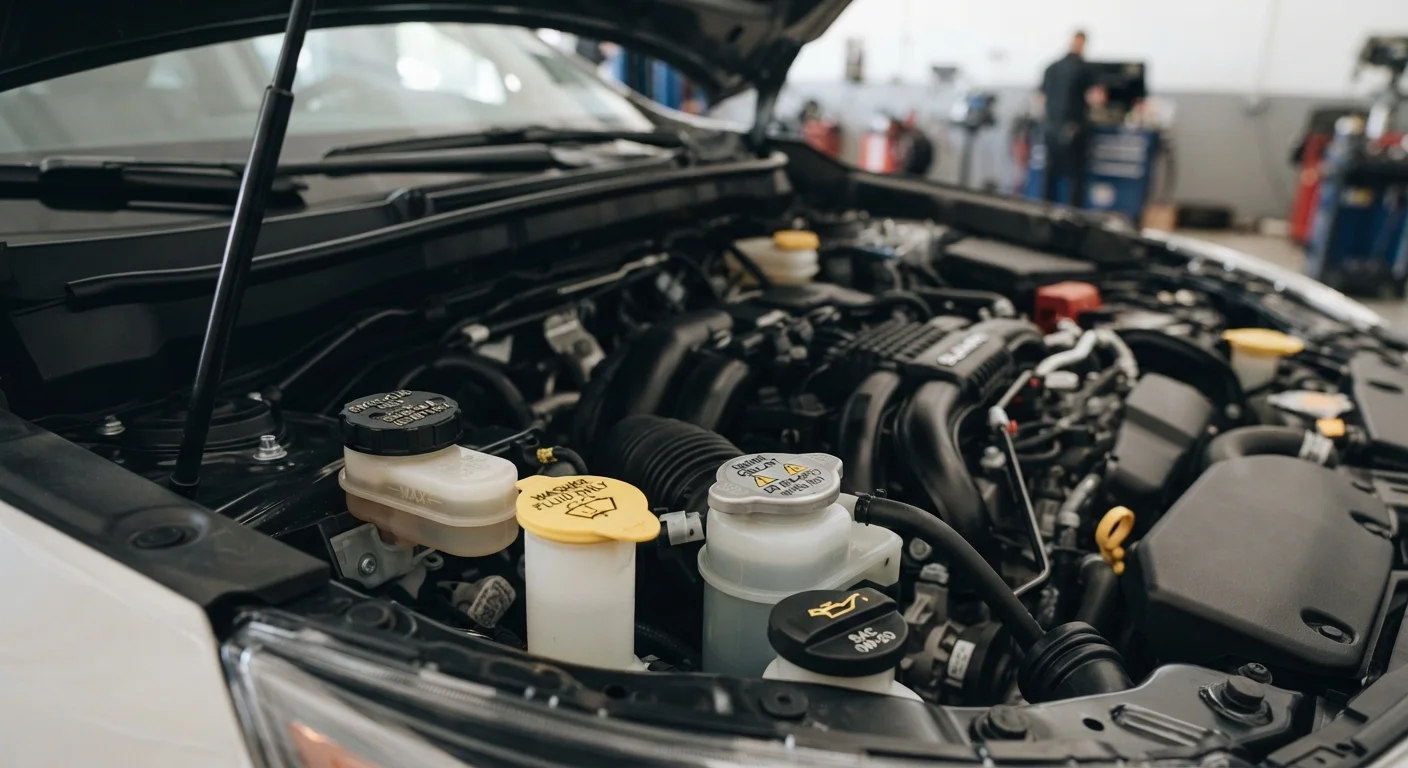
Open your hood and you'll typically find these six reservoirs within reach:
| Number of essential fluids | 6 |
| Brake fluid replacement interval | Every 2 years (typical) (Varies by manufacturer - always check your owner's manual) |
| Coolant flush interval | Every 30,000-50,000 miles (General guideline; consult your vehicle's service schedule) |
| Minimum check frequency for engine oil | Monthly |
| Brake fluid property to watch | Hygroscopic (absorbs moisture) |
| Safe coolant check rule | Engine must be completely cold (Opening a hot radiator cap can cause serious burns) |
1. Engine Oil
Engine oil lubricates moving metal parts, reduces friction-generated heat, and carries microscopic debris away from critical components. Check it with the dipstick when the engine is cold (or at least 10 minutes after switching off). The oil should sit between the two marks on the dipstick and appear amber to dark brown - never milky or gritty. Most modern vehicles call for an oil change every 5,000-7,500 miles, though your owner's manual has the definitive answer. Curious about what those label numbers mean? Learn how to decode oil viscosity grades.
2. Coolant (Antifreeze)
Coolant circulates through the engine to absorb heat and carries it to the radiator where it disperses. It also prevents freezing in winter and corrosion year-round. Check the level in the translucent overflow reservoir - never open the radiator cap on a hot engine, as pressurized coolant can cause serious burns. Top up only when the engine is completely cold. Most manufacturers suggest a full coolant flush every 30,000-50,000 miles.
3. Brake Fluid
When you press the brake pedal, hydraulic pressure transmitted through brake fluid is what actually stops the car. This fluid is hygroscopic - meaning it gradually absorbs moisture from the air - which lowers its boiling point over time and can cause a spongy pedal feel. The reservoir is usually a small, semi-transparent plastic container near the firewall. Most manufacturers recommend replacing brake fluid every two years regardless of mileage.
4. Power Steering Fluid
If your car has hydraulic power steering (rather than electric), this fluid assists in translating your steering wheel movements into actual wheel turns. A low level is often signaled by a whining or groaning noise when turning. The reservoir is typically marked with a steering wheel icon. Note: many newer vehicles use electric power steering and have no fluid reservoir at all - check your owner's manual.
5. Transmission Fluid
Transmission fluid lubricates the gears, clutch packs, and other internal components in both automatic and manual gearboxes. In automatic vehicles, it also acts as a hydraulic fluid. It degrades more slowly than engine oil, but it does degrade. Check it using a dedicated dipstick (on automatics) or consult a mechanic for sealed transmissions, which are increasingly common. Change intervals vary widely - anywhere from 30,000 to 100,000 miles depending on the vehicle.
6. Windshield Washer Fluid
While not mechanically critical, running out of washer fluid while driving in dirty or icy conditions is a genuine safety issue. Use purpose-made washer fluid rather than plain water, which can freeze in the lines and fail to cut through road grime effectively. Check and top up monthly, especially before winter.
Building a Simple Fluid-Check Routine
You don't need to check every fluid every week. A practical cadence looks something like this:
- Monthly: Engine oil level, washer fluid
- Every 3 months or 3,000 miles: Coolant level, brake fluid level, power steering fluid (if applicable)
- At every service interval: Transmission fluid, full brake fluid condition assessment
If a dashboard warning light appears alongside any fluid concern, treat it as urgent - don't wait for your next service appointment. Learn what your warning lights actually mean so you can act quickly when it counts.
Fluid checks pair well with seasonal maintenance. The seasonal car maintenance checklist is a handy reference to keep in your glovebox. And if you've heard that some fluid-related rules are set in stone - like the old 3,000-mile oil change interval - it's worth reading up on common car maintenance myths before your next service.
When in doubt about any fluid's condition or your vehicle's specific requirements, consult a qualified mechanic. A quick visual inspection costs nothing; catching a problem early can save hundreds in repairs.