

Key Takeaways
Why Interior Design Myths Are So Persistent
Decorating advice circulates fast - on social media, in home improvement stores, from well-meaning friends. Some of it is genuinely useful. A lot of it is an oversimplification that hardened into rule somewhere along the way. The trouble is that most of these "rules" were based on one context and then applied universally, regardless of the room's actual light, proportion, or purpose.
If a room never feels quite right despite your best efforts, outdated assumptions may be part of the problem. Our guide on diagnosing why a room feels off covers the underlying mechanics of scale, balance, and flow - many of which the myths below ignore entirely.
Below, we examine the most common small-room decorating myths and what actually happens when you test them against real spaces.
The Myths, Examined
These misconceptions come up constantly in decorating conversations. Each one contains a kernel of logic - which is exactly why they spread.
Myth
Dark paint will make a small room feel smaller and more claustrophobic.
Fact
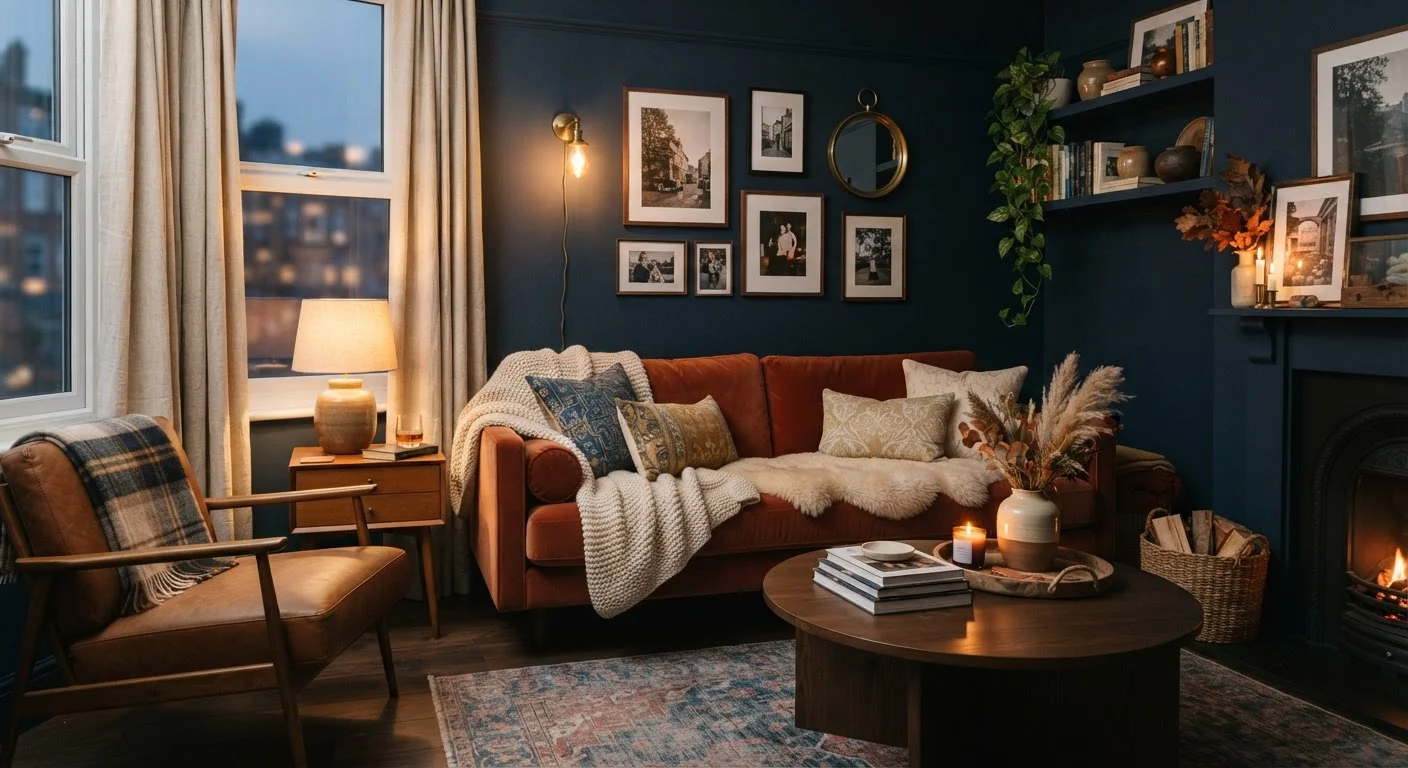
Dark paint can make a small room feel intimate, defined, and even larger by visually receding walls - especially in rooms with adequate lighting.
The logic behind this myth is understandable: light colours reflect more light, so they must make rooms feel bigger. In practice, a dark colour applied consistently - including on trim and ceiling - can blur the boundaries of a room and create a sense of depth. Designers often refer to this as an "enveloping" effect. The real culprits in a cramped-feeling room are typically poor lighting and clutter, not wall colour.
Myth
Hanging a large mirror on any wall will instantly make a small room feel twice as big.
Fact
Mirrors amplify whatever they reflect. If they face a cluttered corner, a blank wall, or a window showing a dark exterior, they can make a room feel more chaotic or dim.
Mirrors work best when positioned to reflect a light source - natural daylight, a lamp, or an attractive view. A mirror facing a window on an opposite wall is a genuinely effective technique. Mirrors scattered randomly, or hung where they reflect the most congested part of a room, tend to add visual noise rather than space. Placement and what the mirror reflects matter as much as the mirror's size.
Myth
Small rooms require small furniture - always choose compact pieces to avoid overwhelming the space.
Fact
Undersized furniture in a small room often creates a cluttered, piecemeal look. One or two well-proportioned anchor pieces typically read better than many small ones.
When every piece of furniture is scaled down to fit a small room, the result is often a space that feels busy and unfocused - like a waiting room filled with mismatched chairs. Interior designers frequently recommend choosing fewer, appropriately scaled pieces and leaving deliberate open floor space. A standard sofa in a small living room can ground the space far more effectively than three miniature loveseats crowded together.
Myth
An all-white room will always look bigger and more open than a coloured one.
Fact
White reflects light well, but a poorly lit all-white room can look flat, dingy, or hospital-like. Colour used intentionally often makes a space feel more alive and considered.
White is not a neutral cure-all. In rooms with limited natural light, white walls can appear grey or yellow depending on the undertone of the paint and the type of artificial lighting used. Colour - including warm mid-tones and saturated hues - gives a room definition and personality. A thoughtfully coloured room with good lighting will often feel more spacious and welcoming than an unthought-out white box.
Myth
Matching furniture sets are the safest choice for a small room because they keep things cohesive.
Fact
Matching sets can make a small room feel showroom-stiff and monotonous. Mixing pieces with a shared colour palette or material tends to look more layered and intentional.
Furniture suites - where every piece is from the same matching collection - became popular for their convenience, but they rarely produce the most visually interesting result. In a small room, visual sameness can actually flatten the space. Mixing furniture of varying heights, finishes, and styles, unified by a consistent colour family or material (wood tones, for instance), creates depth and makes the space feel curated rather than off-the-shelf.
Rug sizing is another area riddled with folklore. If you've been told to keep rugs small so they don't "overwhelm" a space, it's worth reading about how rug placement and size actually affect a room's perceived dimensions - the reality often surprises people.
Moving Past the Rules
Good interior design isn't about following a checklist - it's about understanding cause and effect. When you know why certain choices work, you can adapt them to your specific space rather than applying a one-size-fits-all fix that may not serve you.
Trendy shortcuts - like mirroring every wall or stripping out all color - can create new problems that only become obvious over time. Our piece on decorating choices that look fine at first but cause problems later walks through how to spot those risks before committing.
For a broader foundation, the complete overview of interior design for everyday homeowners covers colour theory, furniture arrangement, and proportion in depth - all useful when you're ready to move beyond the myths and make genuinely informed decisions for your home.