

Key Takeaways
Why Rug Size Changes How a Room Feels
A room's sense of scale, warmth, and coherence often hinges on a single element most people underestimate: the rug. Too small, and a sofa seems to float in open space, disconnected from the rest of the room. Too large, and the rug competes with the walls and crowds the eye. Interior designers frequently point to rug sizing as one of the most common - and most fixable - mistakes in home decorating.
If your room has ever felt vaguely off despite nice furniture and good lighting, the rug may be the invisible culprit. For a deeper look at why rooms feel unbalanced, see our guide on diagnosing layout problems. Understanding a few consistent sizing principles gives you a reliable framework - no design experience required.
The Core Sizing Principles Interior Designers Use
These guidelines apply across room types and furniture styles. They're not rigid rules so much as proportions that consistently produce balanced results.
Always measure the furniture footprint - not just the room - before choosing a rug size.
Rug size should correspond to the grouping of furniture it anchors, not the total floor area. Buying based on room size alone is the most common cause of an oversized or undersized rug.
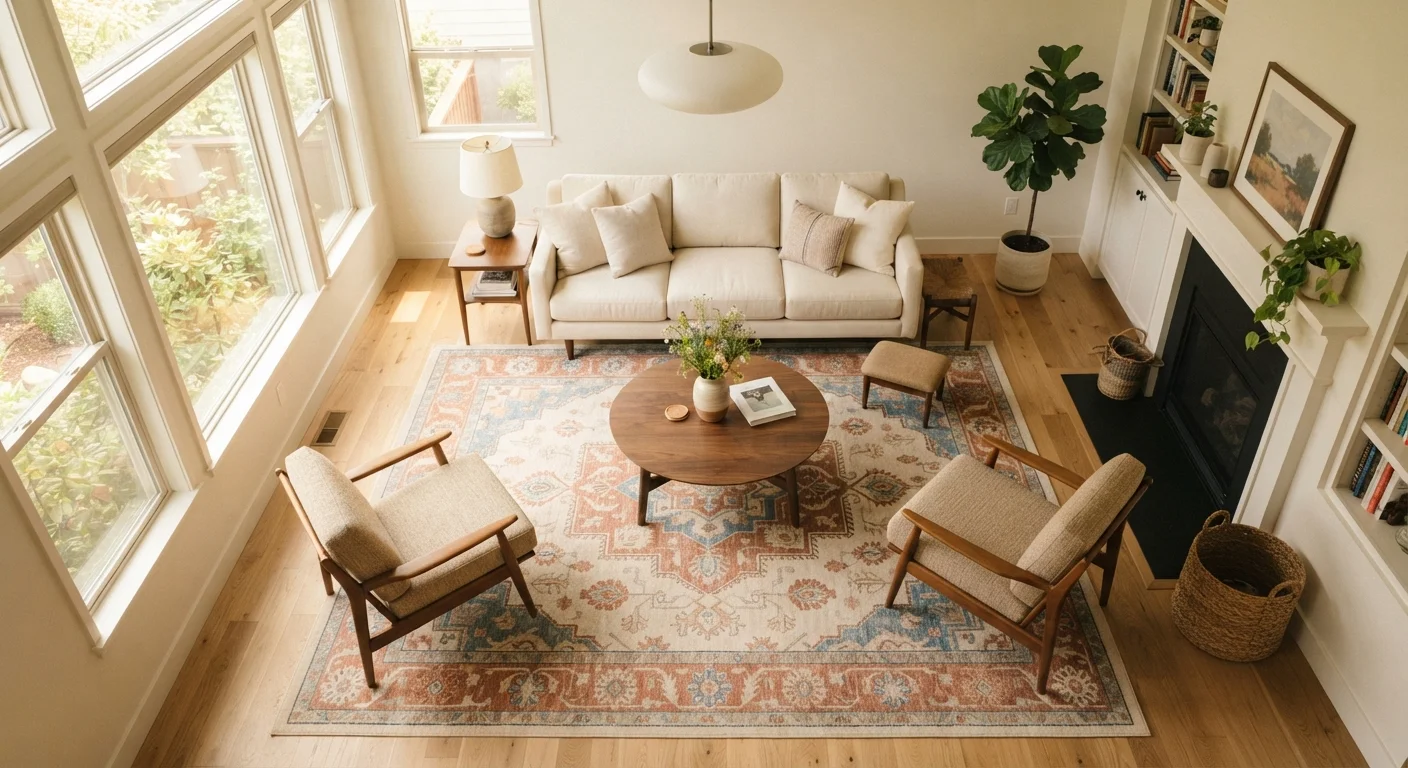
Place at least the front two legs of every seating piece on the rug.
This technique visually connects all the furniture into one cohesive zone. When no legs touch the rug, pieces look unrelated; when all legs are on it, the effect feels purposeful and grounded.
In dining rooms, add at least 24 inches to each side of the table when calculating rug size.
Chairs that catch the rug edge every time they are pulled out create friction - literally and visually. The extra clearance keeps chairs stable and on the rug even when occupied.
Leave a consistent border of bare floor visible around the rug's perimeter.
Exposed flooring frames the rug and signals to the eye that the rug is a deliberate design element, not a floor covering. Aim for 12 to 18 inches of bare floor between the rug edge and the wall.
Use painter's tape to simulate a rug's footprint before purchasing.
Seeing proportions on the actual floor eliminates guesswork and prevents costly returns. It also helps you check that furniture transitions on and off the rug cleanly.
Room-by-Room Guidance
Living Room
In a living room, the standard approach is to place all front legs of every seating piece on the rug. This creates a visual boundary around the conversation area without requiring a rug large enough for all legs to sit fully on it. If your budget or space allows, a rug with all legs fully on it looks the most intentional and grounded.
Dining Room
The 24-inch rule is essential here: the rug must extend at least 24 inches beyond the table edge on all sides. This ensures chairs remain on the rug even when pulled out - a chair leg catching the rug edge every time someone sits down quickly becomes a daily frustration. Measure your table, add 48 inches to both the length and width, and that is your minimum rug size.
Bedroom
Symmetry matters most in a bedroom. A rug should extend 18 to 24 inches beyond both sides and the foot of the bed. For a queen or king, a 8×10 or 9×12 rug typically works well, but always confirm with your specific measurements rather than assuming by bed size alone. Runners placed on each side of the bed are a practical alternative in tighter spaces.
When to Layer Rugs Instead
If you already own a smaller rug you love but it is too compact to anchor your furniture properly, try layering it over a larger, low-pile neutral rug. The base rug provides the anchoring scale while the top rug adds color or texture. This approach works especially well in living rooms and can be a cost-effective way to make a smaller investment piece look intentional.
Measuring Before You Buy
Tape is your best tool here. Before shopping, use painter's tape to mark the rug's intended perimeter on the floor. Arrange your furniture over the tape outline and live with it for a day. This low-cost test reveals whether your chosen dimensions will actually feel right - or whether you should size up. It also highlights traffic-flow issues before they become a problem.
This is part of a broader principle worth applying to any redecoration project. Our room planning checklist walks through measurements and flow considerations before you spend a dollar.
Common Mistakes and How to Avoid Them
The single most repeated mistake is choosing a rug based on the room's total square footage rather than the furniture footprint. A 12×15 room does not need a 12×15 rug - it needs a rug sized to the furniture grouping within it, with several inches of bare floor visible at the perimeter.
Another frequent error is placing a small accent rug in the center of a seating area so that no furniture touches it at all. This creates the opposite of an anchor - it makes the rug look like an afterthought placed in open space. If you are working with a smaller rug, it is better to layer it over a larger neutral base than to float it alone. For more on how decorating decisions create problems over time, see decorating choices that reveal themselves slowly.
Rug placement also interacts with your other textiles. A well-sized rug that clashes in texture or pattern with your curtains or cushions can still feel chaotic. Our piece on textile combinations that add depth without clutter offers practical principles for making everything hold together.