

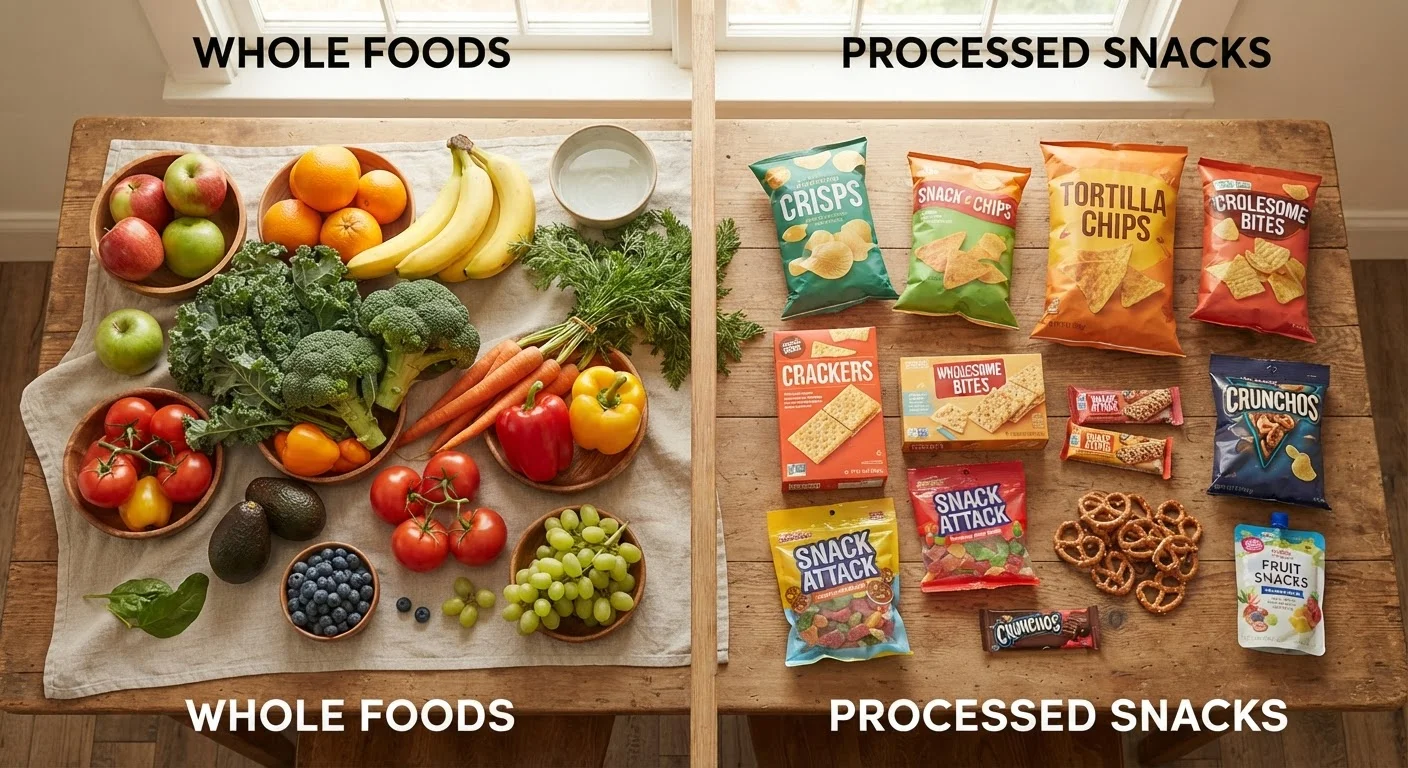
Key Takeaways
Option A
Whole Foods
The minimally altered, nutrient-dense foundation of a healthy diet.
Best for: People who want to maximize nutrient density and minimize additives in their daily meals.
Option B
Processed Foods
A broad spectrum ranging from mildly altered to heavily engineered food products.
Best for: Understanding how modern food preparation and manufacturing affect nutrition is key for informed everyday choices.
If you want to improve overall nutrient intake with minimal effort
Whole Foods
Whole foods provide vitamins, minerals, and fiber in their most intact form, supporting overall health without requiring you to decode lengthy ingredient lists.
If you need convenient, time-saving options on busy days
Processed Foods
Minimally processed options like canned beans, frozen vegetables, or plain yogurt can be nutritious conveniences - the key is choosing items with short, recognizable ingredient lists.
If you are managing a health condition and monitoring sodium or sugar intake
Whole Foods
Whole foods give you full control over what goes into your meals, making it easier to limit additives your healthcare provider may have flagged. Always consult a qualified professional for personalized guidance.
What 'Whole Foods' Actually Means
A whole food is a food that remains close to its natural state with little to no industrial alteration. Think fresh apples, dried lentils, plain oats, raw nuts, or an egg. These foods haven't had nutrients stripped away or synthetic ingredients added in. As a result, they tend to arrive with their original mix of fiber, vitamins, minerals, and phytonutrients (plant compounds that support health) largely intact.
Minimally processed versions of whole foods - such as washed and bagged spinach, pasteurized milk, or frozen peas - still count as close to whole because the processing serves safety or convenience without significantly changing nutritional value. The key question is: how much has changed from what grew in the ground or came from an animal?
For a practical way to evaluate any food you pick up, see our guide to reading a nutrition label - it walks you through ingredient lists and key numbers step by step.
The Processed Food Spectrum
"Processed" is not a single category - it is a spectrum. Food scientists commonly use a framework called NOVA (developed by researchers at the University of São Paulo) that groups foods into four tiers based on the extent and purpose of processing:
- Group 1 - Unprocessed or minimally processed: Fresh produce, plain meat, eggs, plain legumes.
- Group 2 - Processed culinary ingredients: Flour, butter, oil, sugar, salt - used to prepare Group 1 foods at home.
- Group 3 - Processed foods: Canned fish, simple cheeses, cured meats, bread with few ingredients. These are altered mainly for preservation.
- Group 4 - Ultra-processed foods (UPF): Products manufactured with industrial ingredients rarely found in a home kitchen - emulsifiers, colorings, flavor enhancers, hydrogenated oils, high-fructose corn syrup. Examples include packaged cookies, flavored chips, instant noodles, and many breakfast cereals.
Research published in journals such as BMJ and The Lancet has associated high UPF consumption with increased risk of several chronic health conditions, though scientists note that causality is still being studied and diet quality overall matters more than any single category.
| Criterion | Whole Foods | Ultra-Processed Foods |
|---|---|---|
| Ingredient list | One or very few recognizable ingredients | Long list with industrial additives |
| Fiber content | Naturally high in most cases | Typically low or absent |
| Added sugar & sodium | Minimal to none | Often high |
| Micronutrient density | High - vitamins and minerals intact | Low - often nutrient-poor |
| Convenience | Requires more preparation | Ready-to-eat, shelf-stable |
| Cost | Variable; staples can be affordable | Variable; often cheap per serving |
Why Ultra-Processed Foods Deserve Closer Attention
Ultra-processed foods are specifically engineered for palatability - meaning they are designed to taste intensely appealing in ways that can make it easy to eat more than intended. They often contain high amounts of added sugars, sodium, and refined carbohydrates while offering little fiber or micronutrient density. Our companion article on sugar in your diet explains how added and natural sugars differ on labels and in your body.
This doesn't mean a single serving of chips derails your health. The concern is displacement: when ultra-processed foods make up a large portion of daily calories, they tend to crowd out whole foods that provide nutrients your body genuinely needs. Small, consistent shifts - like swapping a packaged snack for a handful of nuts or a piece of fruit a few days a week - tend to be more sustainable than sweeping overhauls.
57%
Share of US daily calories from ultra-processed foods
A study published in BMJ Open estimated that ultra-processed foods account for roughly 57% of daily energy intake among US adults.
~14g
Average daily fiber intake for US adults
The Dietary Guidelines for Americans note most adults consume far below the recommended 25-38g of fiber per day, a gap largely linked to low whole-food consumption.
A Practical Approach for Everyday Eating
Rather than labeling foods as "good" or "bad," a useful mental model is to ask: How close is this to its original form? The shorter and more recognizable the ingredient list, the closer the food is to its whole-food origin.
A few beginner-friendly strategies:
- Build meals around a whole-food base. Start with vegetables, whole grains, legumes, or lean protein, then add other ingredients around them.
- Use minimally processed foods strategically. Canned tomatoes, frozen vegetables, and plain canned beans are nutrient-friendly shortcuts.
- Read ingredient lists, not just nutrition panels. Five or fewer recognizable ingredients is a reasonable rule of thumb for identifying lightly processed options.
- Cook more often when possible. Home cooking naturally shifts meals toward less processing, and it gives you control over sodium and added sugar.
If you are also thinking about protein sources in your diet, our overview of plant-based versus animal protein can help you evaluate whole-food protein options side by side.
This article is for general informational and educational purposes only and is not a substitute for professional medical or dietary advice. Consult a qualified healthcare provider or registered dietitian for guidance tailored to your individual health needs.