

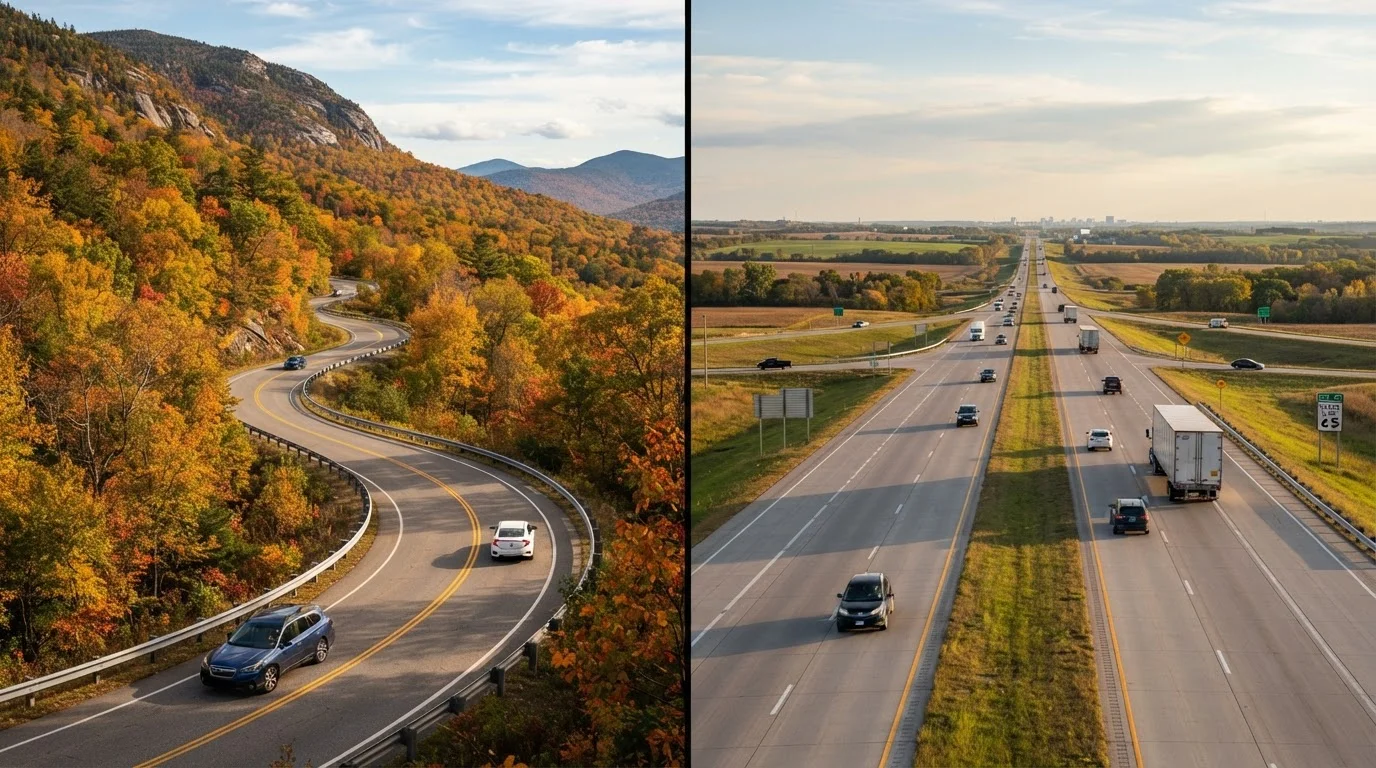
Key Takeaways
Option A
Scenic Routes
The slow, story-rich path through America's most overlooked landscapes.
Best for: Travelers who value discovery, photography, and memorable stops over reaching a destination quickly.
Option B
Interstate Highways
The efficient, predictable backbone of long-distance American road travel.
Best for: Drivers who need to cover serious distance reliably, especially under time or budget constraints.
If you have a firm arrival deadline or limited travel days
Interstate Highways
Predictable speeds, consistent services, and fewer unexpected delays make interstates the reliable choice when time is non-negotiable.
If the journey itself is the point of your trip
Scenic Routes
Scenic byways put you in direct contact with landscapes, towns, and experiences that highways bypass entirely - ideal when discovery is the goal.
If you're traveling with young children or elderly passengers
Interstate Highways
Rest stops, gas stations, and medical facilities are far more accessible along interstates, reducing stress when passenger comfort is a priority.
If you're planning a photography or nature-focused road trip
Scenic Routes
National scenic byways and forest roads pass through viewpoints, wildlife corridors, and natural landmarks that interstates deliberately avoid.
If you want the best of both approaches on a multi-day trip
Scenic Routes
Use interstates to cover flat, featureless stretches efficiently, then peel off onto scenic roads when you reach regions worth savoring.
What Makes These Two Road Types Fundamentally Different
At their core, scenic routes and interstate highways are built for different purposes. Interstates - the numbered I-routes that cross the country - were engineered primarily for speed and commerce. They're wide, well-maintained, and designed to move vehicles efficiently across long distances with minimal interruption. Scenic routes, by contrast, are often designated because of what surrounds them: mountain passes, coastlines, historic towns, national forests, and stretches of landscape that don't appear from a highway overpass.
The Federal Highway Administration designates National Scenic Byways and All-American Roads based on archaeological, cultural, historic, natural, recreational, and scenic qualities. These aren't just pretty drives - they're curated corridors through some of the country's most significant landscapes. Understanding that distinction helps you treat each route type as a tool, not a default.
If you're building your trip from the ground up, see our complete first-timer's road trip guide for a structured starting point before choosing your route type.
Head-to-Head: How Scenic Routes and Highways Compare
The differences between these two road types become most visible when you put them side by side across the factors that actually affect your trip experience. Consider these dimensions before committing to a route:
| Criterion | Scenic Routes | Interstate Highways |
|---|---|---|
| Travel speed | Slower; frequent curves and stops | Faster; consistent highway speeds |
| Fuel & services access | Sparse; plan ahead | Frequent; predictable intervals |
| Scenic and cultural value | High; landscapes and towns | Low to moderate; functional |
| Weather safety | Variable; mountain/rural exposure | More predictable and maintained |
| Navigation complexity | Higher; cell service may be limited | Lower; well-signed throughout |
| Vehicle requirements | May need clearance or AWD | Any standard vehicle |
| Spontaneity potential | High; discover stops en route | Low; exits are planned and uniform |
One commonly overlooked factor is vehicle suitability. Scenic roads occasionally include unpaved sections, steep grades, or narrow lanes that are difficult for large vehicles like RVs or vehicles towing trailers. Always check road specifications for your specific route - not all scenic designations mean the road is paved or wide.
When the Scenic Route Is the Smarter Choice
Scenic routes earn their reputation when the drive itself has value - not just the destination. If you're traveling through a region with significant natural or cultural character, bypassing it on an interstate means missing the point of the trip entirely. The Blue Ridge Parkway in Virginia and North Carolina, the Pacific Coast Highway along California, or the Going-to-the-Sun Road in Montana each offer experiences that no amount of saved time can replace.
Scenic routes also tend to pass through smaller towns that rely on traveler traffic, giving you access to local food, regional character, and unexpected stops. These are often the moments people remember most. That said, this route type rewards preparation. Fuel stations can be sparse, cell service may be limited, and weather conditions in mountain or rural areas can shift rapidly. Check our guide on how seasons shape a road trip route before committing to a scenic road in spring or fall.
Also worth knowing: many routes that seem spontaneous-friendly actually require planning. Assuming you can always figure out fuel and lodging on a scenic byway is one of the more common planning errors.
When the Highway Is the Right Call
Interstate highways deserve more credit than they often get from road trip enthusiasts. For driving through genuinely flat, featureless terrain - long stretches of Kansas, west Texas, or the Nevada basin - there's little scenic trade-off in choosing the faster road. Highways let you bank distance efficiently so you can spend more time where it actually matters.
Interstates are also significantly more practical in bad weather. Wider lanes, better drainage, consistent signage, and easier access to emergency services make them the safer environment when rain, wind, or fog is a factor. If you're traveling with passengers who need regular comfort breaks, the density of rest stops and services along major interstates is a genuine advantage.
48,000+
Miles in the US Interstate Highway System
The US Interstate Highway System spans more than 48,000 miles, according to the Federal Highway Administration, making it one of the most extensive road networks in the world.
150+
Federally designated National Scenic Byways
The US Department of Transportation's National Scenic Byways Program has designated over 150 roads across 46 states as scenic byways or All-American Roads.
30-90 min
Typical added time per scenic segment
Taking a scenic byway instead of a parallel interstate typically adds 30 to 90 minutes per segment, depending on road length and posted speed limits.
For driving that's primarily about reaching a destination - a family event, a pre-booked itinerary, or a regional hub you'll explore on foot - the highway earns its place. The goal is always to match the road to the purpose, not to default to one type reflexively. Our article on why road trips fall apart before they begin covers how over-ambitious scenic detours without adequate planning time are among the most common trip-derailing mistakes.
Building a Hybrid Route: The Practical Middle Ground
Most experienced road trippers don't treat this as a binary choice. A well-designed multi-day itinerary often uses interstates to cover distance quickly between regions, then transitions onto scenic roads when the landscape or destination justifies it. This approach lets you maximize both efficiency and experience without sacrificing either entirely.
A simple framework: identify the two or three stretches of your trip with the most scenic or cultural value, and plan to take the slower road there. Use navigation tools to calculate the time difference - often it's 30 to 90 minutes per scenic segment, which is manageable when you build it into your schedule. For guidance on tools that help you plan layered routes, see what experienced road trippers use for navigation.
If you're planning a destination-specific trip such as a Southwest loop, the logic of route sequencing becomes especially important - see our guide on road-tripping the American Southwest for a real-world example of blending both road types intelligently.