

Key Takeaways
Our Verdict
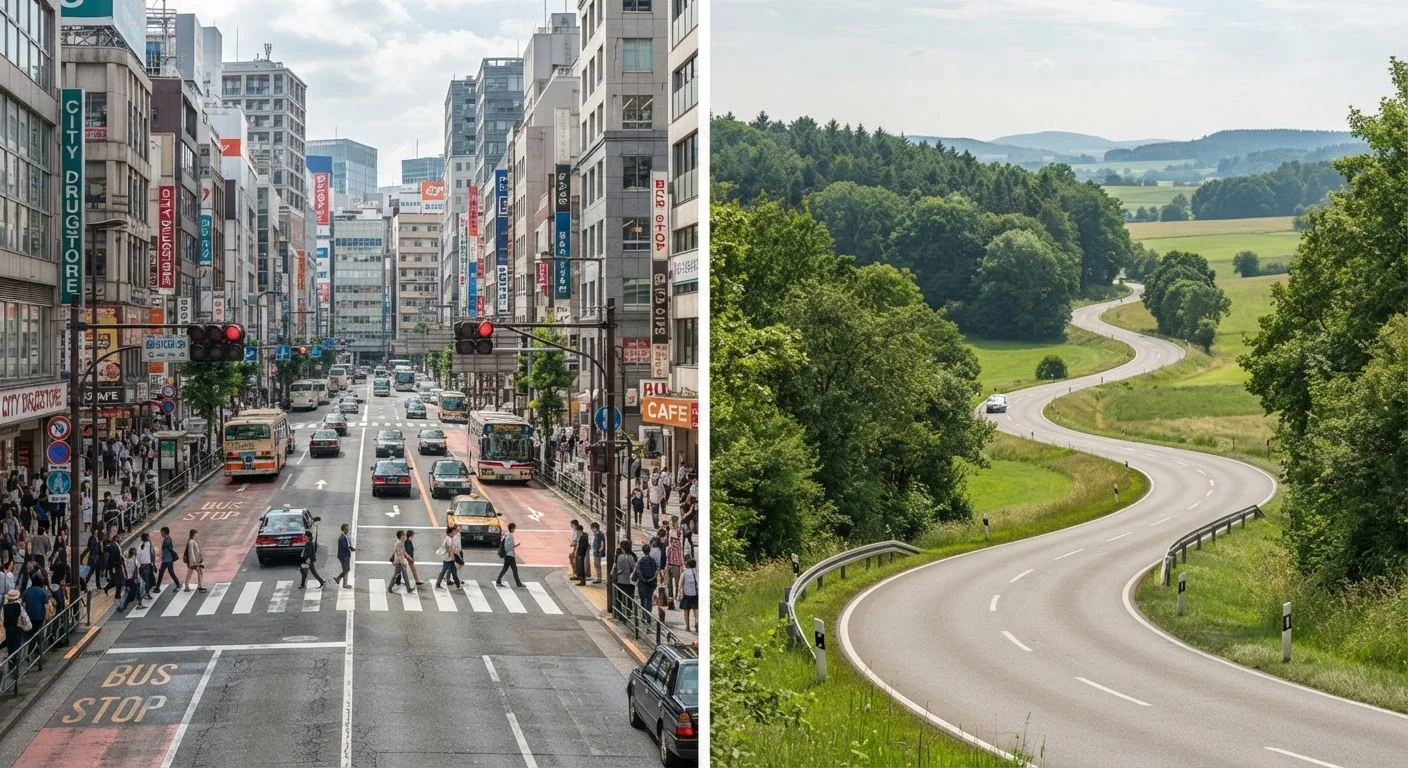
Neither urban nor rural driving is inherently more dangerous - each environment presents its own distinct set of risks that demand specific skills. Urban driving tests patience, precision, and pedestrian awareness at lower speeds, while rural roads demand speed management, wider visual scanning, and fatigue awareness. Building competence in both makes you a genuinely well-rounded driver.
| Best for | Recommended |
|---|---|
| Drivers building initial confidence in controlled, low-speed settings | Urban Driving |
| Drivers comfortable with speed who want to practice open-road awareness | Rural Roads |
| Drivers preparing for long road trips through varied terrain | Both environments practiced deliberately |
Why the Environment Changes Everything
Most beginner drivers learn in one familiar setting - often the suburbs or their local town - and assume those skills transfer automatically everywhere. They mostly do, but not entirely. The core rules of driving stay constant, but the hazards you're most likely to encounter shift dramatically depending on whether you're navigating city blocks or open country lanes.
Understanding what each environment demands helps you stay alert in the right ways rather than applying a one-size-fits-all approach. For a broader look at how anticipation works on any road, see how experienced drivers anticipate hazards before they happen.
| Urban Driving | Rural Roads | |
|---|---|---|
| Typical speed range | 20-35 mph | 45-65+ mph |
| Primary hazards | Pedestrians, cyclists, junctions | Blind bends, animals, road surface |
| Crash severity | Often lower due to slower speed | Often higher due to speed and isolation |
| Visibility challenges | Buildings, parked cars, tight corners | Crests, blind bends, poor lighting |
| Fatigue risk | Lower - high stimulation | Higher - monotony reduces alertness |
| Emergency response time | Generally fast | Often significantly delayed |
| Key skill required | Patience and precision scanning | Speed management and wide scanning |
Urban Driving: Managing Complexity at Lower Speeds
City and suburban roads are dense with information. At any given moment, you may be watching traffic lights, pedestrians stepping off curbs, cyclists filtering through gaps, buses pulling out, and parked cars with opening doors - all while crawling along at 20-35 mph. The lower speeds are deceptively reassuring; collisions at these speeds can still cause serious injury, particularly to pedestrians and cyclists.
Key urban hazards to anticipate
- Pedestrian unpredictability: People crossing mid-block, children running ahead of parents, and distracted phone users are common. Scan doorways, gaps between parked cars, and crosswalks continuously.
- Junctions and right-of-way confusion: Intersections, roundabouts, and merging lanes require constant priority awareness. If you find junctions stressful, roundabout and right-of-way rules are worth reviewing.
- Stop-start traffic: Frequent braking and acceleration increases both cognitive load and the risk of rear-end collisions. Maintain a generous following distance even in slow traffic.
- Limited visibility: Tall buildings, parked vehicles, and tight corners all restrict sightlines. Slow down before you can see clearly, not after.
Urban driving rewards calm patience and a methodical scanning pattern. Hurrying through city traffic rarely saves meaningful time and significantly increases risk.
Rural Roads: Managing Speed and Isolation
Open country roads feel freeing - wide skies, less traffic, and a smoother pace. But rural roads account for a disproportionately high share of serious road fatalities in the US. The reasons are straightforward: higher speeds, limited crash barriers, narrower lanes, and much longer emergency response times combine to make collisions more severe when they do occur.
Key rural hazards to anticipate
- Blind bends and crests: You cannot see what's around a curve or over a hill. Drive at a speed that allows you to stop within the distance you can see clearly ahead.
- Animal crossings: Deer, livestock, and other wildlife appear suddenly, especially at dawn and dusk. Scan field edges and roadsides continuously.
- Variable road surfaces: Gravel, mud, potholes, and uneven camber are far more common on rural roads. Reduce speed when surfaces look inconsistent.
- Oncoming vehicles straddling the center: Tractors, wide farm vehicles, and drivers drifting toward the middle are real hazards on narrow lanes. Stay left and be ready to slow or stop.
Fatigue is a particular rural risk. Long, monotonous stretches reduce alertness faster than complex city driving does. Learn to recognise the signs early - see how to manage driver fatigue on long roads before planning any extended rural journey.
The Skills That Carry Across Both Environments
While urban and rural driving each demand specific adjustments, several core skills improve your safety everywhere:
- Scanning well ahead: Whether anticipating a pedestrian in the city or a blind bend in the country, looking further down the road gives you more time to react.
- Speed appropriate to conditions: The posted limit is a maximum, not a target. Adjust for weather, visibility, and road surface. Driving in poor weather conditions compounds the risks in both environments.
- Consistent following distance: The two-second rule (minimum) applies on city roads; on rural roads at higher speeds, extend this to three seconds or more.
- Mental preparation: Before any unfamiliar route, take a moment to consider what type of road you'll be on and what hazards are most likely. This mental shift primes you to notice the right things.
Building genuine confidence behind the wheel means practicing both environments deliberately, not just defaulting to the one you know. The full guide to building driving confidence offers a structured approach for drivers working to feel assured in any situation.