
Reading the Road: How Experienced Drivers Anticipate Hazards Before They Happen

Key Takeaways
Why Hazard Perception Is a Skill, Not Instinct
Many new drivers assume that avoiding accidents is mostly about reflexes - that experienced drivers simply react faster when something goes wrong. Research into driver behavior tells a different story. What separates a confident, safe driver from a nervous one is rarely reaction speed; it's how far ahead they're reading the road.
Hazard perception means identifying conditions, behaviors, or situations that could require you to change speed or direction - before they become emergencies. Experienced drivers don't just see the road; they interpret it. A ball rolling across the street means a child may follow. A delivery truck with hazard lights on signals a door about to open. This kind of predictive thinking is learned, not inherited, and you can begin building it today.
This skill is part of a broader foundation of driving confidence covered in our full guide for beginner and anxious drivers.
Core Practices for Reading the Road Ahead
The following practices form the foundation of proactive hazard perception. Each one is concrete and immediately applicable, regardless of how long you've been driving.
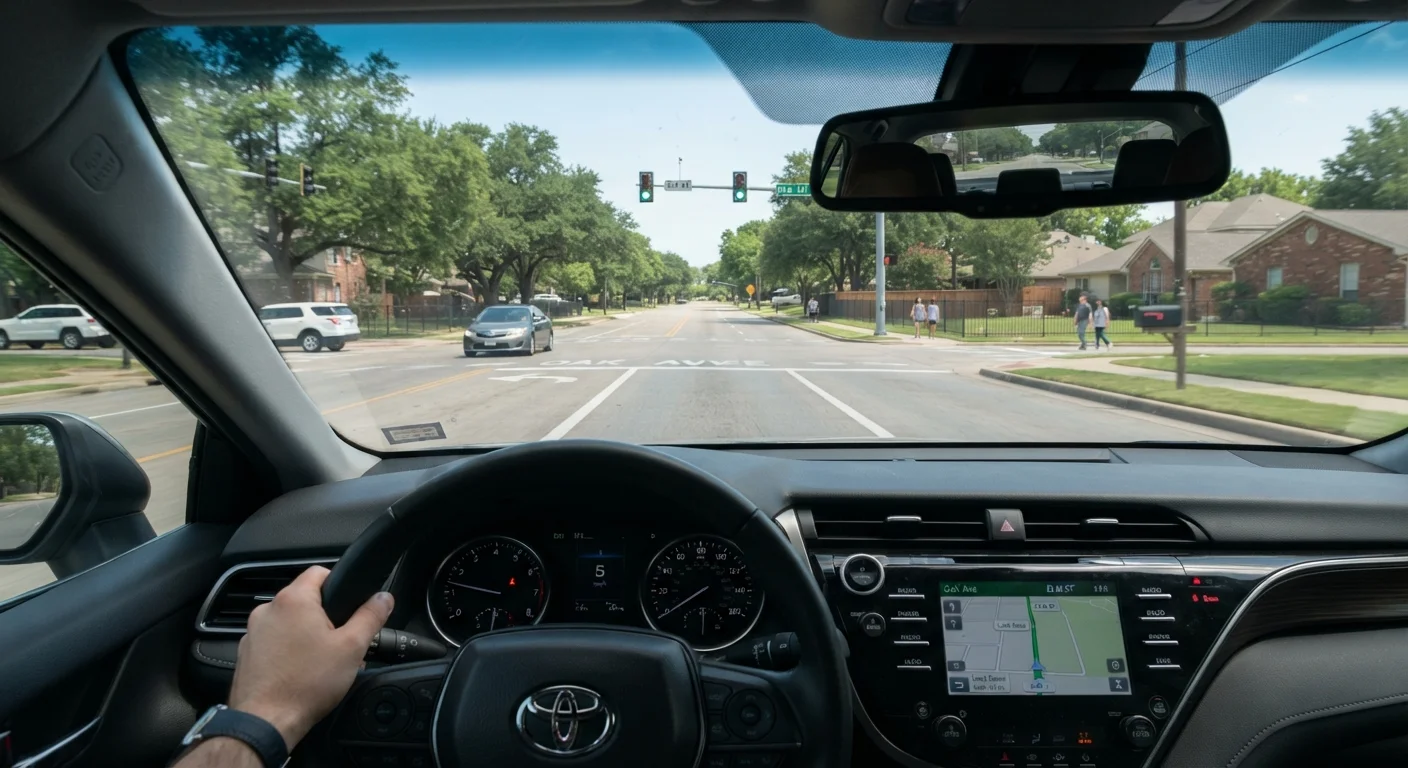
Scan at least 12 seconds ahead, not just the car in front of you
At 40 mph, 12 seconds of forward vision gives you roughly 700 feet of road to assess. Focusing only on the vehicle immediately ahead leaves you with almost no time to respond to anything beyond it. Most rear-end collisions happen because drivers are watching too short a distance ahead.
Maintain a following distance of at least three seconds from the vehicle ahead
Following distance is your buffer for decision-making. A three-second gap at highway speeds translates to roughly 200 feet - enough room to brake safely even if the car ahead stops suddenly. In wet or icy conditions, double this to six seconds or more.
Actively check your mirrors every five to eight seconds
Knowing what's behind and beside you is as important as knowing what's ahead. Sudden braking or lane changes affect not just the vehicle in front of you but everyone behind. Mirror checks give you a complete mental picture of the traffic environment.
Reduce speed proactively when something feels uncertain
Speed reduces both your reaction time and the margin for error if something goes wrong. Lifting off the accelerator before a potential hazard - even if it never materializes - costs you only a few seconds. Waiting until danger is confirmed can cost much more.
Watch pedestrians and cyclists for behavioral cues, not just their position
A pedestrian looking at their phone, a cyclist wobbling, or a child chasing something all signal potential movement into your path. Position alone doesn't tell you what someone is about to do - their behavior does.
Identify an escape route before you need one
If a hazard forces sudden action, knowing where you can go - a gap in traffic, a shoulder, a wider lane - means you respond purposefully rather than in panic. This habit is especially valuable on multi-lane roads and highways.
Context Clues: What the Environment Is Telling You
Every road environment carries information. Learning to read these signals turns your drive from a reactive experience into a managed one.
- Parked vehicles: Always assume a door could open or a pedestrian could step out. Give them space where traffic allows.
- School zones and residential streets: Narrower roads plus pedestrians - especially children - demand a lower default speed and wider attention.
- Intersections: Even on a green light, scan left and right before committing. Red-light violations are among the most common collision causes.
- Large vehicles ahead: Trucks and buses block your line of sight. Increase your following distance so you can see past them and spot hazards they may be reacting to.
Urban and rural roads each present their own distinct hazard profiles. If you frequently drive both, our article on urban versus rural driving hazards breaks down exactly what to watch for in each setting.
Practice Commentary Driving to Sharpen Your Perception
Commentary driving means narrating what you see aloud as you drive - 'pedestrian on the left, gap closing, slowing slightly.' It may feel awkward at first, but it forces your brain to actively process rather than passively observe. Even a five-minute session on a familiar route can reveal how much you normally miss. Try it alone or with a trusted passenger.
Applying These Skills in Challenging Conditions
Hazard perception becomes significantly harder when visibility drops. Rain, fog, and low light all compress the amount of road you can read ahead of you - which is precisely when these skills matter most.
The core principle stays the same: slow down to match your reaction distance to your sight distance. If you can only see 100 feet ahead in fog, driving at a speed that requires 200 feet to stop safely is not a manageable risk. Our guide to driving in rain, fog, and low light covers this in depth.
Darkness adds another layer. Depth perception and peripheral awareness both decline after sundown, making the scanning habits described in this article even more critical. For a closer look, see our piece on how night driving affects more than visibility.