

Key Takeaways
Why Parallel Parking Feels So Hard
Parallel parking intimidates more new drivers than almost any other maneuver - and for understandable reasons. You're reversing, steering in multiple directions, monitoring multiple mirrors, and trying not to hold up traffic, all at the same time. The good news is that parallel parking is a procedural skill, not an instinctive one. It follows a repeatable sequence, and once you understand the reference points involved, the guesswork disappears.
If other close-quarters scenarios cause you anxiety too, our guide on parking in tight spaces and on hills covers the broader range of situations that trip up new drivers. For now, let's focus entirely on the parallel park.
What you will need
What You'll Need Before You Start
Before attempting parallel parking on a live street, make sure you've reviewed the basics. Comfort with low-speed reversing and smooth mirror use will make this significantly easier.
All three mirrors (rearview + both side mirrors)
Used continuously throughout the maneuver to monitor the gap between your car and surrounding vehicles.
Reference cones or cardboard boxes
Used when practicing in an empty lot to simulate the front and rear vehicles without risk of contact.
Parking sensors or rear camera (if your vehicle has them)
Provides additional proximity alerts, but should supplement - not replace - mirror and direct-view checks.
Once you have these in place, find a quiet residential street or - ideally - an empty parking lot where you can simulate the maneuver using cones or cardboard boxes before doing it for real.
The Step-by-Step Parallel Parking Sequence
Follow this sequence consistently and it will work across the vast majority of standard parking spaces. Every step matters - skipping ahead is usually what causes kerb scrapes.
Identify a suitable gap
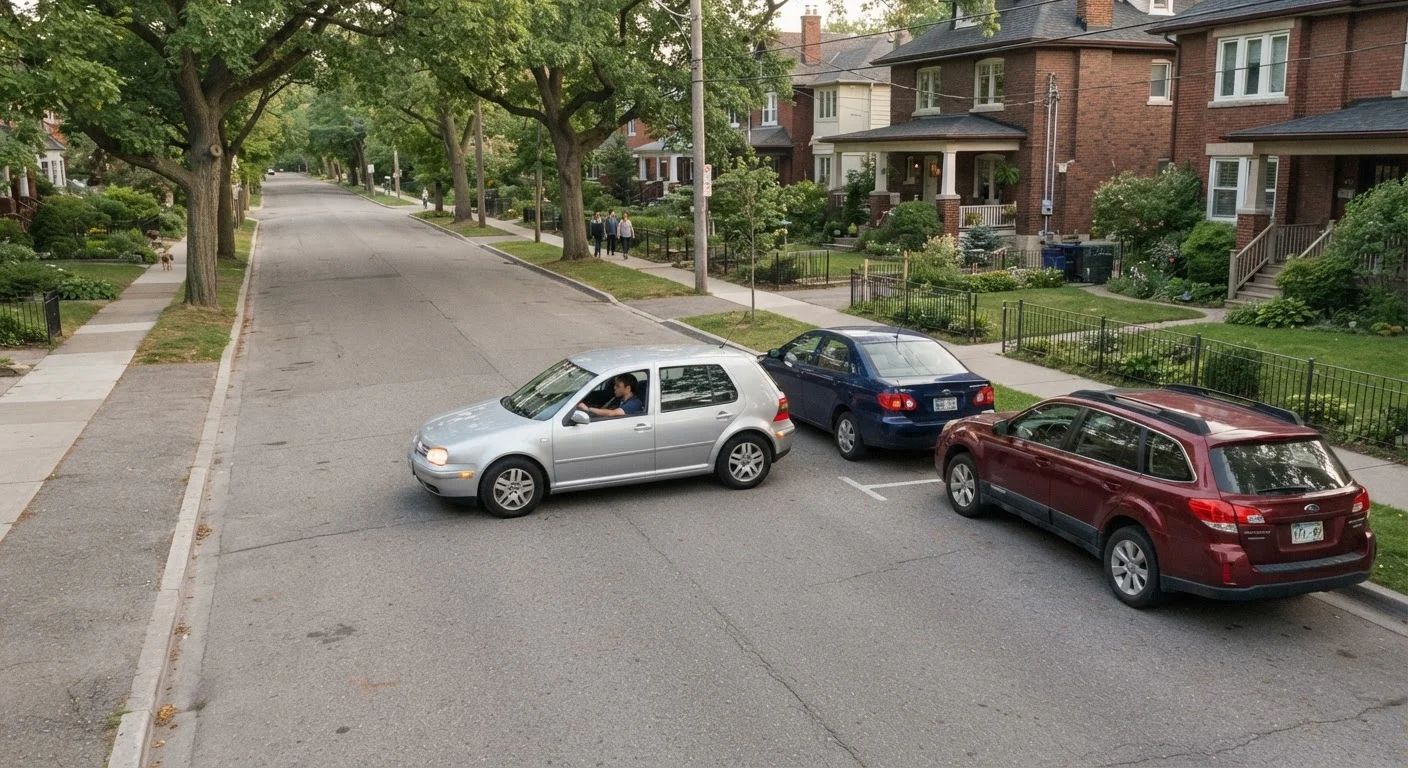
Look for a space that is at least one and a half times the length of your car. Pull up alongside the vehicle in front of the space, leaving about two to three feet of lateral distance between your cars. Align your rear bumper roughly with the rear bumper of that front vehicle.
Signal, check mirrors and blind spots
Activate your right turn signal to alert other road users that you intend to park. Check your rearview mirror, right side mirror, and physically look over your right shoulder into the blind spot. Wait until traffic has cleared before beginning the reverse.
Reverse straight back briefly
Shift into reverse and begin moving slowly - walking pace or slower. Reverse in a straight line until your rear axle (roughly the midpoint of your rear doors) is in line with the rear bumper of the front parked vehicle. Keep your wheels straight during this phase.
Steer toward the kerb
Once your rear axle is at your reference point, begin steering smoothly toward the kerb - turning the steering wheel toward the parking space (right side in the US). Continue reversing slowly. Your goal is to angle the rear of your car into the space at roughly 45 degrees. Watch your right side mirror to monitor the distance to the kerb.
Straighten the wheel and continue reversing
When you can see in your right mirror that the rear of your car is about 12-18 inches from the kerb, begin straightening the steering wheel while continuing to reverse slowly. At the same time, check your left mirror to ensure your front bumper has cleared the rear of the vehicle in front.
Counter-steer to bring the front in
Once your car is roughly parallel with the kerb, steer away from the kerb (left) while continuing to reverse slowly. This swings your front bumper into the space and brings the car parallel. Stop when you've reached a safe distance from the vehicle behind you - aim to leave roughly 12-18 inches of clearance at both ends.
Straighten up and center the car
Shift into drive and edge forward to center yourself within the space, leaving roughly equal clearance to the vehicles in front and behind. Straighten your wheels fully before switching off the engine. Apply the parking brake as appropriate for your vehicle and the road surface.
Once you've completed the maneuver, check that your front and rear bumpers aren't protruding into the travel lane, and that you're within roughly 12 inches of the kerb. If either condition isn't met, pull out and retry - that's completely normal, even for experienced drivers.
Common Mistakes and How to Avoid Them
Most parallel parking errors fall into a small number of categories. Recognizing them early helps you self-correct before they become habits - a theme explored more broadly in our article on habits new drivers pick up that are hard to shake.
- Turning too early: Beginning the reverse steer before your rear bumper clears the front vehicle pulls your nose out into traffic instead of tucking it in.
- Steering too fast: Quick steering wheel movements at low speed are difficult to undo. Slow hands give you time to read the situation.
- Not checking blind spots: Mirrors alone don't show everything behind you. Use the rear window directly during the reversing phase.
- Choosing a space that's too small: If the gap is less than one and a half times your car's length, move on to the next space.
Practice the Sequence Before the Street
Set up two cardboard boxes in an empty parking lot to represent the front and rear vehicles. Running through the full sequence five or six times in a low-stakes environment builds the muscle memory and spatial awareness that make real-street attempts far less stressful. Even a single practice session makes a measurable difference.
Parallel parking is one of many skills that contribute to genuine driving confidence. Whether you're working up to motorway driving for the first time or navigating roundabouts more fluently, every skill you add makes the whole picture clearer. For a structured path forward, see our comprehensive guide to building driving confidence as a beginner.