
Parking on Hills, in Tight Spaces, and at Angles: Scenarios That Trip Up New Drivers

Key Takeaways
Why Parking Trips Up So Many New Drivers
Most new drivers feel confident once the car is moving - it's the stopping part that causes the real anxiety. Parking on a slope, squeezing into a narrow urban spot, or reversing into an angled bay all demand a combination of spatial awareness, vehicle control, and knowledge of the rules. Miss one element, and you risk a rolling car, a scraped bumper, or a fine.
The good news is that each of these scenarios follows a clear logic once you understand what you're trying to achieve. The tips below walk through the most common parking challenges one at a time, so you can build genuine skill rather than just hoping for an easy spot. For a deeper look at building overall confidence behind the wheel, see the full beginner's confidence guide.
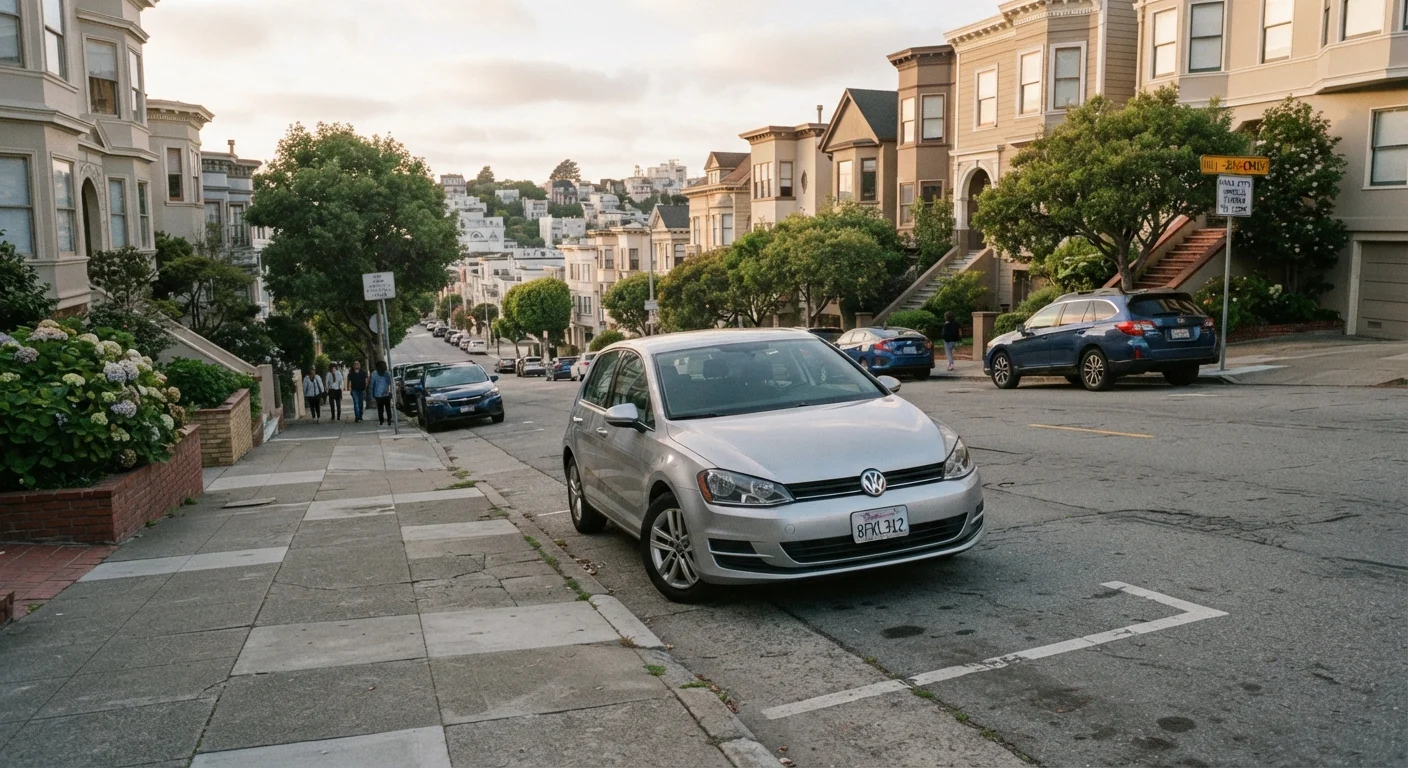
Parking Facing Downhill: Turn Wheels Toward the Curb
When your car is pointed downhill, there is one non-negotiable rule: turn the front wheels toward the curb before you leave. If the parking brake were to fail - or if the car were bumped - the wheel would catch on the curb and stop the vehicle from rolling into traffic.
The sequence matters: bring the car to a complete stop, apply the parking brake firmly, then turn the wheel toward the curb. If you're driving an automatic, shift to Park last. On a manual transmission, select first gear (facing uphill) or reverse (facing downhill) as an added measure - but this is not a replacement for the handbrake.
Before exiting, visually confirm that your tires are angled and touching or nearly touching the curb. A quick check takes seconds and could prevent a serious incident.
Turn wheels toward the curb facing downhill - the curb is your backup brake if something fails.
Parking Facing Uphill: Turn Wheels Away From the Curb
The logic reverses when you're facing uphill. Here, your front wheels should be turned away from the curb - pointing toward the center of the road. If the parking brake fails, the car will roll backward and the rear of the tire will meet the curb, stopping the vehicle.
A simple memory aid: downhill = toward curb, uphill = away from curb. Both approaches use the curb as a physical backstop, just from different angles. If there is no curb - on a rural road or open lot - turn the wheels so the car would roll off the road rather than into traffic if it moved.
Apply the parking brake before taking the car out of gear, and confirm the wheels are correctly angled before walking away.
Facing uphill, wheels angled away from the curb lets the tire catch the curb if the car rolls back.
Tight Parallel Spaces: Use Reference Points, Not Guesswork
Parallel parking into a narrow street space is the scenario new drivers dread most. The key shift in mindset is to treat it as a series of small, controlled moves rather than one fluid arc. Rushing causes overcorrection; patience creates accuracy.
Pull alongside the car in front, roughly level with its rear bumper and about two feet away. Begin reversing while turning the wheel toward the curb. When your front seat aligns with the rear bumper of the car ahead, counter-steer to straighten the car into the space. Adjust with small forward and backward movements to center yourself.
For a full breakdown of reference points and positioning cues, see our dedicated guide on parallel parking without the panic. That step-by-step approach removes the guesswork entirely.
Parallel parking is a series of small controlled moves - not one single sweeping turn.
Angle Parking: Reversing In Is Safer Than Driving In
Angled bays are common in parking lots and some street situations. Many new drivers pull straight forward into them - it feels easier - but reversing in is generally the safer approach. When you reverse in, you exit the space driving forward with full visibility of pedestrians and passing traffic.
To reverse into an angled bay, pull past the space until its far edge aligns with your rear door. Begin reversing while steering toward the space. Use your mirrors to keep equal distances on each side, and stop before your bumper clears the painted line at the back.
If you do drive in forward, take extra care when exiting. Reverse slowly, pausing before the front of your car clears the adjoining vehicles - that's the moment your front bumper swings into traffic. Sound your horn lightly if visibility is very limited.
Reversing into angled bays means you exit facing forward - with full visibility of the road ahead.
Parking on Camber: Compensating for an Uneven Surface
Roads are often cambered - meaning they slope slightly from the center toward the gutter to drain rainwater. Parking on a heavily cambered road means one side of your car sits lower than the other. This isn't just uncomfortable; it affects how the parking brake holds and how easy the car is to get moving again.
Apply the parking brake more firmly on a noticeable camber, and be prepared for the car to resist steering slightly when you first pull away. On very steep cambers, it's worth shifting into first gear (manual) or leaving an automatic in Park with the brake firmly set.
If you're unsure whether a surface camber is affecting your brake hold, check by gently and briefly releasing the brake while your foot remains on the foot brake - the car should stay completely still before you walk away.
A road's sideways slope (camber) affects how firmly your parking brake needs to be applied.
Multi-Storey and Underground Car Parks: Low Speed, High Awareness
Enclosed parking structures combine low visibility, tight turning radiuses, pedestrians, and other maneuvering vehicles - all at once. The correct mindset is slow and deliberate. Speed limits inside car parks are low for good reason; even minor collisions at these speeds can cause significant damage.
When driving through a multi-storey, stay well to the left and use your mirrors actively at every corner. Before reversing into a space, check the bay for pillars or obstacles that camera systems might miss. Leave enough clearance on the driver's side to open your door fully without hitting the adjacent vehicle.
On exit ramps that spiral downward, use engine braking (a lower gear on a manual, or light foot-brake pressure on an automatic) to maintain a steady, controlled speed rather than riding the brakes continuously all the way down.
In enclosed car parks, slow and deliberate beats fast and rushed every single time.
Practice Makes Parking Automatic
The scenarios above feel daunting the first time but become second nature with repetition. Find a quiet hill during off-peak hours and practice the wheel-turn-and-brake sequence until it's a habit. Walk an empty parking lot to study the angle lines before trying to reverse into a bay. The muscle memory you build in low-pressure situations transfers directly to real-world streets.
Nervous drivers often develop subtle avoidance habits - circling for a flat spot, skipping destinations without parking lots - which limit confidence over time. If this sounds familiar, our article on early driving habits that are hard to shake is worth a read. Consistent, deliberate practice is the only reliable shortcut.
Practice on a Quiet Hill First
Before tackling a busy slope or urban street, find an empty side road on a gentle incline during off-peak hours. Run through the wheel-turn and handbrake sequence repeatedly until the steps feel automatic. Muscle memory built in low-pressure environments transfers directly to real-world situations where you're under time pressure.