

Key Takeaways
Why Early Habits Are So Hard to Unlearn
Learning to drive is one of the few skills where early repetition is so intensive that patterns - good and bad - embed themselves quickly. In the first weeks behind the wheel, your brain is working hard to automate basic controls so it can focus on traffic. Whatever technique you repeat during that period tends to become your default, whether or not it's correct.
This is why instructors and experienced drivers often say a newly-passed driver can be harder to coach than a complete beginner. The habits aren't random; they're logical responses to early anxiety that made sense at the time but become counterproductive as driving gets more complex. The goal here is to name those habits clearly so you can interrupt them before they calcify.
For a broader look at building lasting confidence, see our complete guide for beginner and anxious drivers.
The Most Common Confidence-Killing Habits
The mistakes below appear across nearly every new driver's early experience. Recognising yours is the first step to correcting it.
Relying on mirrors instead of physically checking blind spots before changing lanes or pulling away.
Why it happens: Mirrors feel safer because they don't require taking eyes off the road ahead. New drivers often underestimate how much a mirror misses at certain angles.
Hesitating too long at junctions, either stopping when the gap is clearly safe or pulling out when it isn't.
Why it happens: Without a well-developed sense of speed and distance, new drivers struggle to judge whether a gap is large enough - so they either wait indefinitely or guess and go.
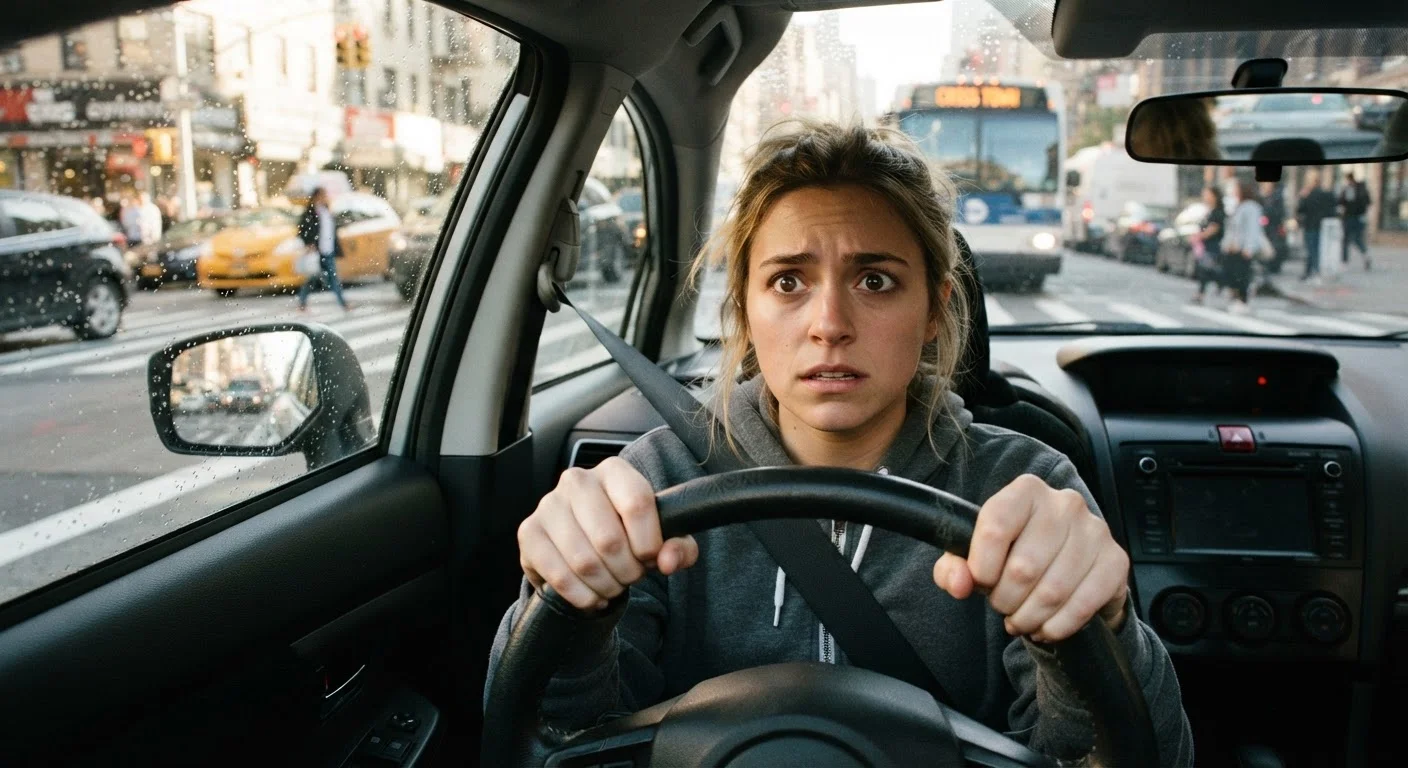
Gripping the steering wheel too tightly, causing tense, jerky steering inputs and physical fatigue.
Why it happens: Anxiety triggers a natural tightening response. New drivers often believe a firm grip means better control, when the opposite is usually true.
Looking too close to the front of the car rather than scanning further ahead along the road.
Why it happens: Anxiety causes tunnel vision. When a driver feels overwhelmed, their gaze naturally drops closer to give a sense of control over the immediate space.
Braking too late and too hard, resulting in jerky stops and reduced margin for error.
Why it happens: This is usually a direct consequence of not scanning far enough ahead - the hazard is spotted late, so braking is urgent. It can also reflect a misunderstanding of stopping distances. For a deeper look, see common braking myths new drivers believe.
Avoiding manoeuvres like parallel parking entirely rather than practising them to build competence.
Why it happens: A difficult first attempt creates a strong avoidance memory. Driving routes start to be planned around skipping specific situations rather than developing the skill.
Many of these habits are closely connected. For example, poor forward observation (scanning too close to the car's bonnet) directly causes late braking and junction hesitation - fix one and you often weaken the others. If you want to understand how experienced drivers read the road far ahead, our article on anticipating hazards before they happen explains the skill in practical detail.
Correcting Bad Habits Without Losing Confidence
The most effective approach to breaking an embedded driving habit is to isolate it and practise the correct version deliberately - ideally on a quiet road or empty car park before applying it in live traffic. Trying to fix multiple habits at once usually leads to overload and regression.
Keep a short mental note after each drive: one thing you did well, one thing you'll adjust next time. This kind of low-pressure self-review is far more effective than waiting for something to go wrong. If freezing or anxiety is part of the picture, understanding the psychology helps - why nervous drivers freeze behind the wheel breaks down exactly what's happening and how to manage it.
As your baseline habits improve, extending into more demanding scenarios - motorway driving, poor weather, night journeys - becomes far less intimidating. See our guides on first-time motorway driving and driving in rain and low light when you're ready to take the next step.
Don't Practise Bad Habits in High-Stress Situations
If you're already anxious about a specific scenario - merging on a freeway, reversing in a tight lot - attempting it repeatedly without structured guidance can reinforce the wrong technique. Seek a calm environment or a qualified instructor before tackling the scenario in live, pressured traffic. Building the skill correctly first is far more efficient than trying to unlearn an ingrained error later.