

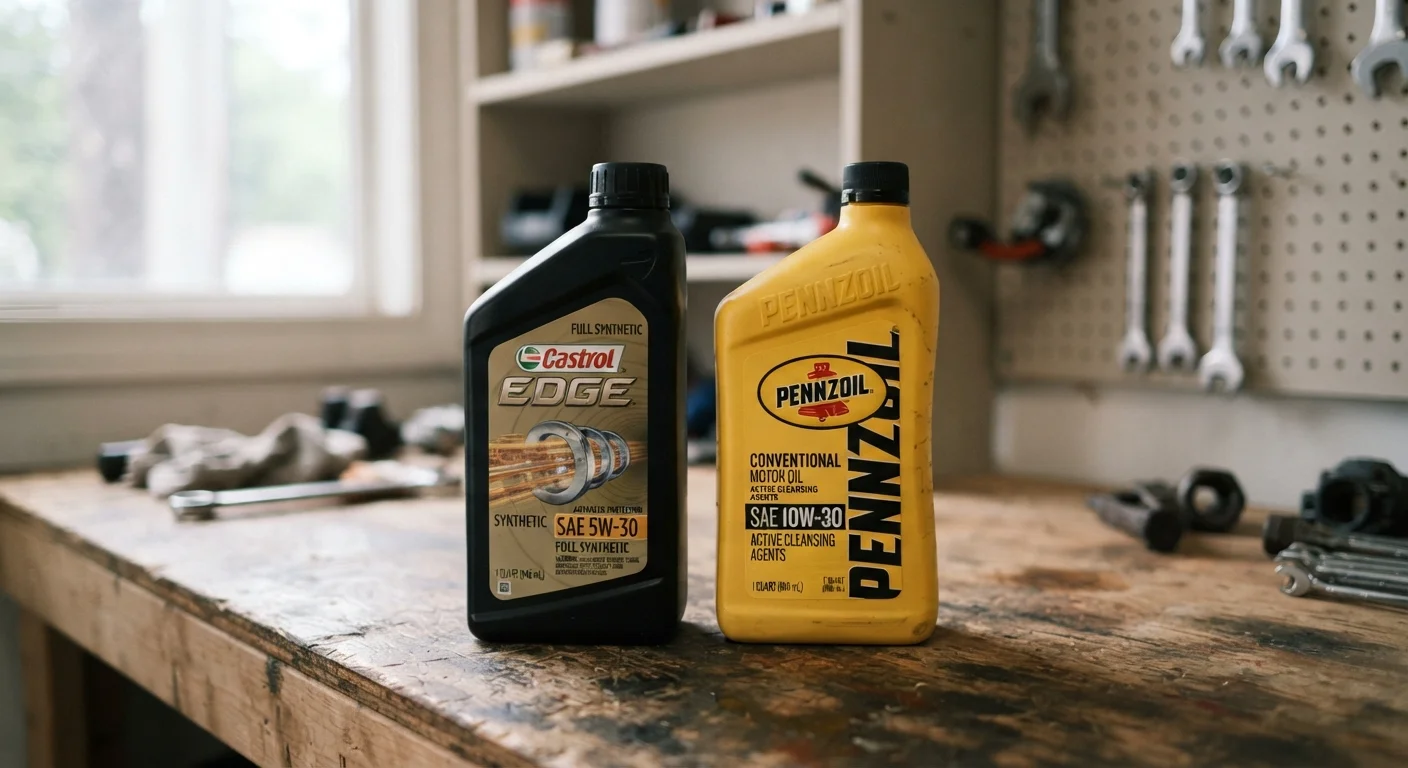
Key Takeaways
Option A
Synthetic Motor Oil
The engineered, high-performance option.
Best for: Drivers who want longer intervals between oil changes, operate in extreme temperatures, or own a modern or performance-oriented vehicle.
Option B
Conventional Motor Oil
The time-tested, traditional choice.
Best for: Drivers with older, simpler engines who follow frequent oil change schedules and want to keep maintenance costs straightforward.
If you drive a newer vehicle with a turbocharged engine
Synthetic Motor Oil
Turbocharged engines run hotter and require oil that maintains its protective properties under high stress. Synthetic handles these conditions more reliably.
If you own an older, high-mileage vehicle with a simple engine
Conventional Motor Oil
Older engines sometimes seal better with conventional oil, and the lower cost per change makes frequent maintenance more affordable.
If you drive in extreme cold or hot climates
Synthetic Motor Oil
Synthetic oil flows more readily in cold starts and resists breakdown at high temperatures, providing better protection across temperature extremes.
If you drive mostly short distances at moderate temperatures
Conventional Motor Oil
For low-stress, routine driving in mild conditions, conventional oil performs adequately and keeps costs predictable.
If your vehicle manufacturer specifically requires synthetic
Synthetic Motor Oil
Some modern engines are engineered with tighter tolerances that require synthetic oil - using conventional may void your warranty or cause accelerated wear.
What Makes These Two Oils Different
Motor oil has one fundamental job: to lubricate your engine's moving parts, reduce friction, carry away heat, and keep metal surfaces from grinding against each other. Both synthetic and conventional oil do this - but they're made very differently, and those differences matter in practice.
Conventional motor oil is refined from crude petroleum pumped out of the ground. During refining, impurities are removed, but the molecular structure remains somewhat irregular and inconsistent. This isn't a flaw exactly - conventional oil has lubricated engines reliably for decades - but those irregularities do affect how the oil behaves under stress.
Synthetic motor oil is built in a laboratory. Chemists engineer its molecules to be uniform in size and shape, which produces oil that flows more predictably, resists breakdown longer, and performs more consistently across a wider range of temperatures. Think of it as crude oil's more precisely manufactured cousin.
To understand more about what motor oil does alongside other fluids in your car, see our guide to key engine fluids.
| Criterion | Synthetic Motor Oil | Conventional Motor Oil |
|---|---|---|
| Source | Chemically engineered in a lab | Refined from crude petroleum |
| Typical change interval | 7,500-15,000 miles | 3,000-5,000 miles |
| Cost per quart | Higher | Lower |
| Cold-weather performance | Flows readily in low temps | Can thicken in cold starts |
| High-temperature stability | Resists thinning under heat | More prone to breakdown |
| Best engine fit | Modern, turbocharged, high-performance | Older, simpler engines |
Performance, Longevity, and Real-World Cost
One of the most common questions drivers ask is whether synthetic oil is actually worth the higher price per quart. The answer depends on how you weigh upfront cost against long-term value.
5,000 mi
Typical conventional oil change interval
Most conventional oil formulations are rated for 3,000-5,000 miles under normal driving conditions, though your owner's manual is the definitive guide.
10,000+ mi
Common synthetic oil change interval
Many full synthetic formulations are rated for 7,500 to 10,000 miles or more, reducing how often drivers need to schedule oil changes.
~80%
Engine wear occurring at cold start
Industry sources have long noted that a significant proportion of engine wear happens in the first moments after a cold start, when oil must flow quickly to protect metal surfaces.
Conventional oil typically needs changing every 3,000 to 5,000 miles - a rule that was once considered universal. Synthetic oil, because it degrades more slowly, often extends that interval to 7,500 miles or more, with some formulations rated for 10,000 to 15,000 miles depending on the vehicle and driving conditions. Fewer oil changes mean less time in the shop and potentially lower total annual spending, even if each individual change costs more.
In cold weather, synthetic oil flows more freely when you first start your engine - a critical moment when most engine wear actually occurs. In extreme heat or stop-and-go traffic, synthetic resists thinning better than conventional, maintaining its protective film between metal surfaces. For everyday, moderate-climate drivers who change their oil on a regular schedule, conventional oil performs adequately. But for anyone pushing their engine harder - or simply wanting maximum protection with less frequent maintenance - synthetic makes a strong practical case.
It's worth dispelling one persistent myth: you don't need to change your oil every 3,000 miles regardless of type. Our article on car maintenance myths covers this and other outdated rules that can waste your money.
How to Know Which Oil Is Right for Your Vehicle
The single most reliable source for this decision is your vehicle's owner's manual. Manufacturers specify not just the oil type (synthetic or conventional) but the viscosity grade - the numeric code like 5W-30 or 0W-20 that describes how the oil flows at different temperatures. If you'd like to understand those numbers in plain language, our explainer on oil label numbers breaks it down clearly.
Some modern engines - particularly those with turbochargers or very tight manufacturing tolerances - are designed specifically for synthetic oil. Using conventional in these engines can accelerate wear or, in some cases, affect your warranty coverage. When in doubt, follow the manufacturer's recommendation rather than the advice on the oil change shop's wall.
If you're considering changing your own oil, it's a task many drivers handle successfully at home. However, it does involve safely lifting the vehicle and disposing of used oil responsibly. Our guide on DIY vs. mechanic tasks can help you decide whether an at-home oil change is the right call for your situation and skill level.
This article provides general educational information about motor oil types and is not a substitute for the guidance in your vehicle's owner's manual or advice from a qualified mechanic.