

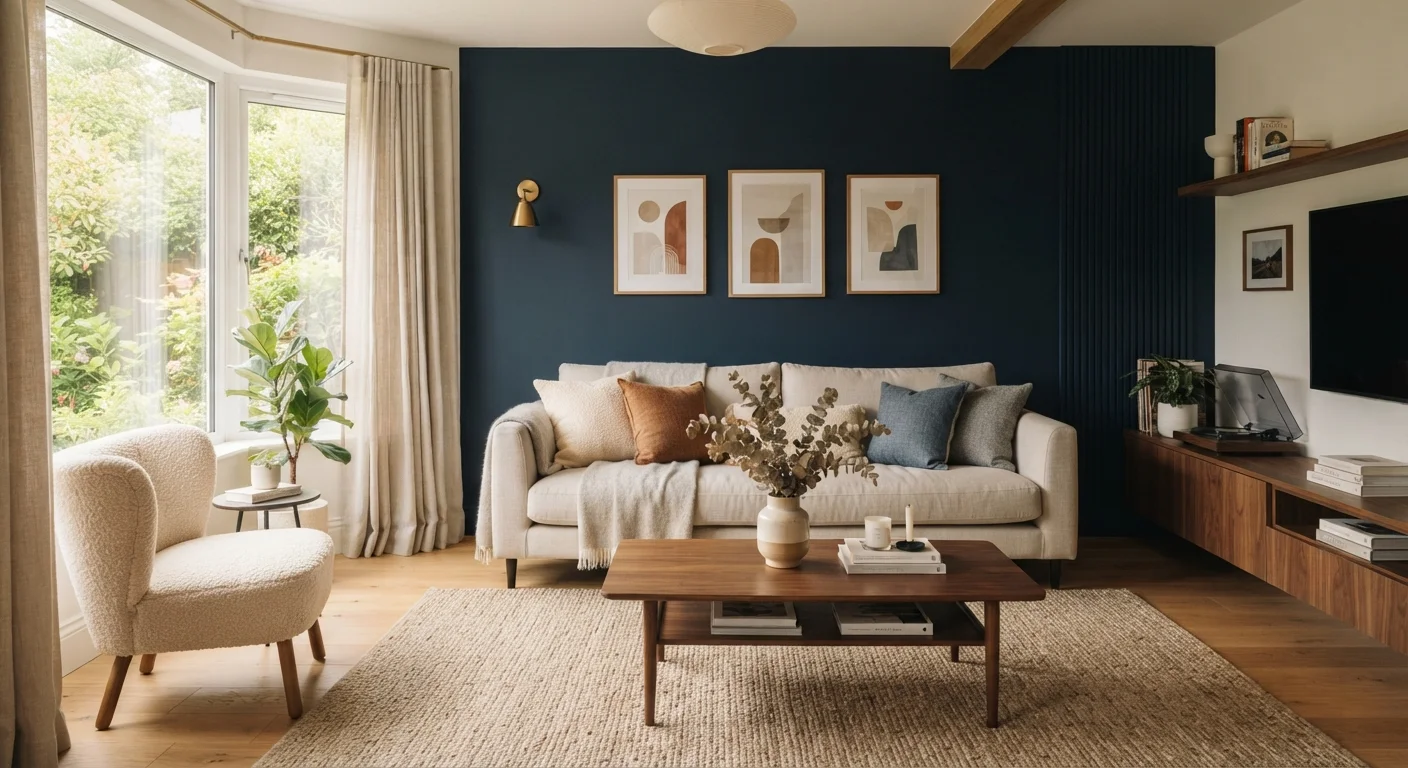
Key Takeaways
Creates an immediate focal point in any room
A treated wall gives the eye a clear anchor, which makes furniture arrangements read as more deliberate and the room feel more composed overall.
Low cost relative to a full repaint
Treating one wall uses significantly less paint or material, making it a budget-friendly way to introduce a bold or premium treatment.
Relatively easy to change with paint
A painted accent wall can be covered in an afternoon - typically with a coat of primer and one or two topcoats - giving you flexibility to update as your taste evolves.
Adds perceived depth and dimension
A deeper or contrasting color on one wall can make a room feel layered rather than flat, particularly in open-plan spaces that might otherwise feel undifferentiated.
Low-risk way to test bold colors
Committing a bold shade to a single wall is far less visually overwhelming than applying it to all four, letting you gauge how a color behaves in your specific light conditions.
Wrong wall choice creates visual imbalance
An accent wall placed on a non-focal surface - such as a sidewall with no furniture anchor - can make a room feel lopsided rather than intentional.
Dark colors can shrink smaller rooms
A very deep or saturated shade on a wall draws that surface forward visually, which can compress the perceived size of an already compact space.
Non-paint treatments are difficult to reverse
Wallpaper, shiplap, and stone veneer require substantial effort to remove and can damage drywall underneath, making the commitment far greater than it first appears.
Trend-driven choices date quickly
Some accent wall styles become strongly associated with a particular era; a treatment that feels current today may read as dated within a few years if it's tied to a passing trend.
Can clash with furniture after rearrangement
An accent wall anchors a room to one furniture layout; if you later rearrange, the focal point and the seating may no longer align, disrupting the room's visual logic.
Our Verdict
An accent wall is a genuinely useful design tool when chosen thoughtfully - the right wall, the right treatment, and a color or pattern that already speaks to your existing furnishings. Done carelessly, it can date quickly, shrink a room, or create a visual imbalance that's costly to fix. Weigh the commitment level of your chosen treatment against your willingness to reverse course.
Homeowners who have a clear sense of their design direction and want to add depth or a focal point to a room without repainting every surface.
What an Accent Wall Actually Does
An accent wall - sometimes called a feature wall - is a single surface in a room treated differently from the other three. That treatment might be a contrasting paint color, wallpaper, wood paneling, stone veneer, or even a bold mural. The underlying principle is the same: concentrate visual interest on one plane to create a focal point and add depth.
In theory, this solves a real problem. Plain rooms with identical walls on all sides can feel flat and unresolved. A single treated wall gives the eye somewhere to land, which can make furniture arrangements feel more intentional and spaces feel more designed. That said, the outcome depends heavily on which wall you choose, what you put on it, and how well it works with everything else already in the room.
Before committing, it helps to have a settled sense of your overall design direction. See our guide to finding your personal style before you buy anything for a practical starting point.
The Real Advantages
When an accent wall lands well, the benefits are tangible rather than cosmetic.
Creates an immediate focal point in any room
A treated wall gives the eye a clear anchor, which makes furniture arrangements read as more deliberate and the room feel more composed overall.
Low cost relative to a full repaint
Treating one wall uses significantly less paint or material, making it a budget-friendly way to introduce a bold or premium treatment.
Relatively easy to change with paint
A painted accent wall can be covered in an afternoon - typically with a coat of primer and one or two topcoats - giving you flexibility to update as your taste evolves.
Adds perceived depth and dimension
A deeper or contrasting color on one wall can make a room feel layered rather than flat, particularly in open-plan spaces that might otherwise feel undifferentiated.
Low-risk way to test bold colors
Committing a bold shade to a single wall is far less visually overwhelming than applying it to all four, letting you gauge how a color behaves in your specific light conditions.
One underappreciated advantage is cost efficiency. Painting one wall in a premium color - or even a higher-end specialty finish - uses far less product than treating an entire room. This makes it a practical entry point for experimenting with deeper, richer shades that might feel overwhelming at full room scale.
The Genuine Drawbacks
Accent walls attract enthusiasm precisely because the commitment feels limited - but that perception can be misleading, depending on the treatment chosen.
Wrong wall choice creates visual imbalance
An accent wall placed on a non-focal surface - such as a sidewall with no furniture anchor - can make a room feel lopsided rather than intentional.
Dark colors can shrink smaller rooms
A very deep or saturated shade on a wall draws that surface forward visually, which can compress the perceived size of an already compact space.
Non-paint treatments are difficult to reverse
Wallpaper, shiplap, and stone veneer require substantial effort to remove and can damage drywall underneath, making the commitment far greater than it first appears.
Trend-driven choices date quickly
Some accent wall styles become strongly associated with a particular era; a treatment that feels current today may read as dated within a few years if it's tied to a passing trend.
Can clash with furniture after rearrangement
An accent wall anchors a room to one furniture layout; if you later rearrange, the focal point and the seating may no longer align, disrupting the room's visual logic.
Wallpaper, shiplap, stone veneer, and similar materials raise the stakes considerably compared to paint. Removal is labor-intensive and sometimes damaging to the underlying drywall. If you're drawn to a non-paint treatment, read our overview of decorating choices that create problems later before committing.
1 wall
Typical accent wall treatment per room
Design consensus generally holds that treating more than one wall in a room defeats the focal-point purpose and creates visual competition.
~25%
Paint used vs. a full four-wall repaint
Treating a single wall of a standard-sized room typically requires roughly one quarter the paint of painting all four walls, reducing both cost and waste.
Choosing the Right Wall - and the Right Treatment
Most design guidance points to the wall that naturally draws attention when you enter a room: the one behind a sofa, a bed headboard, or a fireplace. These are architectural anchors that already function as focal points, so a bold treatment reinforces existing structure rather than fighting it.
Avoid accent walls on surfaces that are heavily interrupted by windows, doors, or built-ins - fragmented planes make the treatment look unintentional. Smaller rooms generally benefit from lighter accent colors rather than very dark ones, which can compress the perceived depth of the space.
The finish you choose matters as much as the color. A flat or matte finish on an accent wall reads quietly; a satin or semi-gloss will catch light and feel more assertive. Our breakdown of paint finish types explains which sheens suit which situations. Once you've settled on direction, painting a room the right way walks through proper prep, priming, and application technique.
Sample Your Color Before Committing
Accent wall colors can shift dramatically depending on a room's natural and artificial light. Paint a large swatch - at least 12 by 12 inches - directly on the intended wall and observe it at different times of day before purchasing full quantities. What reads as a warm terracotta in a paint chip can appear quite orange under afternoon sun, or muddy under warm artificial light. This step takes very little time and can prevent a costly mistake.
When to Skip the Accent Wall
An accent wall isn't always the answer. Rooms with strong architectural features - exposed beams, large picture windows, or ornate moldings - often have enough built-in visual interest already. Adding a bold wall on top can feel competitive rather than complementary.
Renters face an obvious constraint: most leases require walls to be returned to neutral. Paint is generally manageable; wallpaper and cladding are not. If your tenure is short or uncertain, a removable wallpaper or a large-format art piece mounted on a plain wall can deliver a similar focal-point effect without the permanence.
Similarly, if you're still figuring out your furniture arrangement, hold off. An accent wall anchors a room in a specific configuration - move the sofa to the opposite wall after painting, and the focal point no longer aligns with the seating, leaving the room feeling off-balance.