

| Primary test objective | Assess safe, independent driving ability |
| Main competency areas | Control, observation, hazard response, decision-making, road signs |
| Instant fail threshold | One serious or dangerous fault |
| Most fault-prone location | Junctions and roundabouts |
| Examiner's role | Neutral observer scoring competency - not seeking errors |
The Test Is a Competency Check, Not a Gotcha
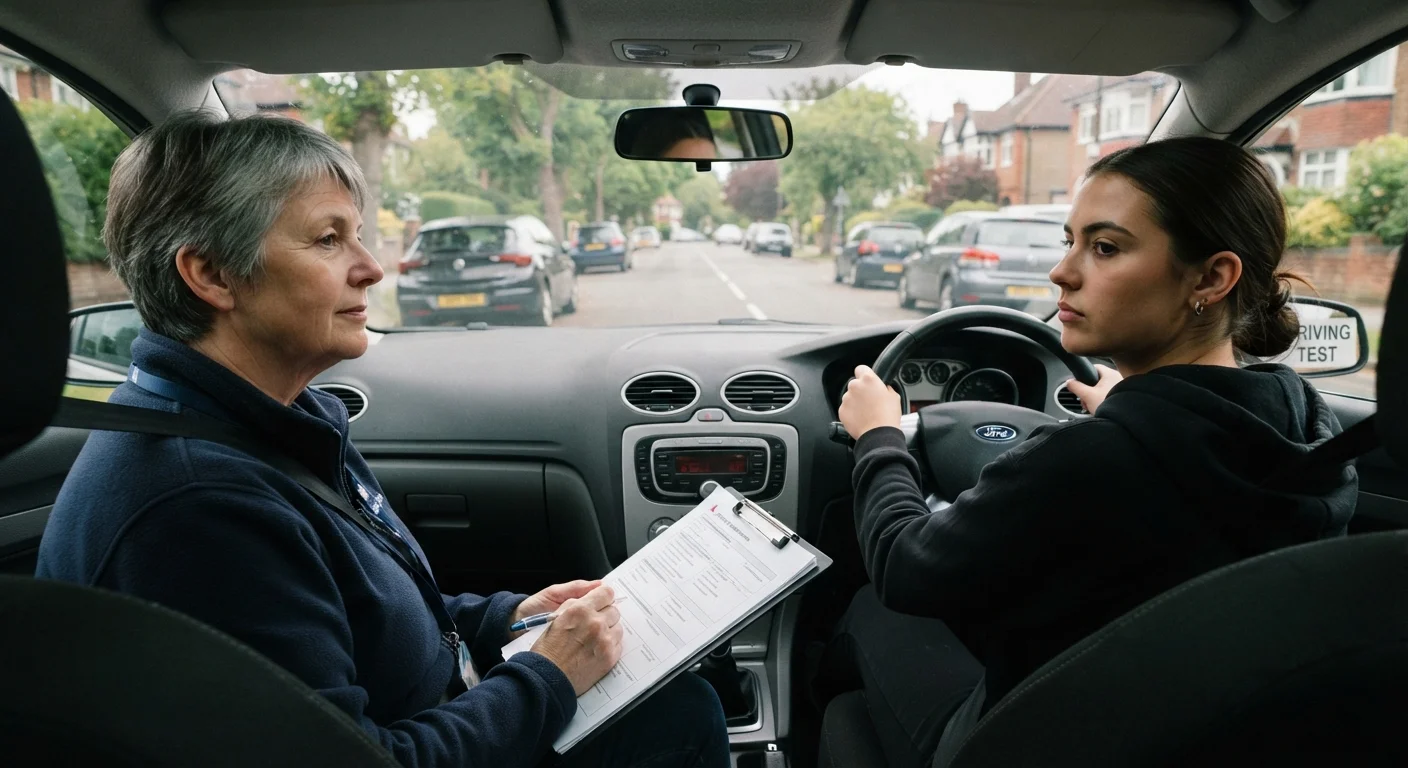
Many learner drivers picture the driving examiner as someone waiting to catch a mistake. In reality, examiners are trained to assess whether you can drive safely and independently - not to trip you up. Their job is to observe a consistent set of competencies across a standardized route and record what they see, neutrally.
Understanding what those competencies actually are transforms how you prepare. Instead of dreading the unknown, you can practice against a clear checklist. The broad areas assessed are: vehicle control, observation and hazard awareness, decision-making at junctions and roundabouts, interaction with other road users, and following road signs and signals correctly.
| Primary test objective | Assess safe, independent driving ability |
| Main competency areas | Control, observation, hazard response, decision-making, road signs |
| Instant fail threshold | One serious or dangerous fault |
| Most fault-prone location | Junctions and roundabouts |
| Examiner's role | Neutral observer scoring competency - not seeking errors |
This reference guide breaks each area down so you know exactly what the examiner is watching - and what good looks like in practice. For a wider view of building assurance behind the wheel, see our full guide to driving confidence.
The Core Competency Areas Explained
Vehicle Control
This covers steering, acceleration, braking, and gear changes. Examiners look for smooth, progressive inputs - not jerky acceleration, harsh braking, or coasting in neutral where it affects control. They're checking whether you keep the car stable and positioned correctly in the lane, especially through bends and when stopping at junctions.
Observation
Effective observation means scanning ahead, checking mirrors at the right moments, and making your checks visible - particularly shoulder checks (sometimes called blind spot checks) before moving off, changing lanes, or turning. Examiners note whether your mirror checks are genuine and timely, not a last-second flick performed as a ritual.
Hazard Awareness and Response
A hazard is anything that could require you to change speed or direction - a pedestrian stepping off the curb, a parked car blocking a lane, a cyclist pulling out. The examiner watches whether you identify hazards early and respond with appropriate space and speed, rather than reacting late.
Decision-Making at Junctions and Roundabouts
Junctions are where most test faults occur. Examiners assess whether you approach at the right speed, yield to traffic correctly, and choose safe gaps - neither forcing your way in nor waiting so long that traffic builds unnecessarily behind you. Hesitation that causes confusion for other drivers can also be recorded as a fault.
Road Signs, Signals, and Lane Discipline
You're expected to follow all signs, signals, and road markings - including speed limits, lane arrows, and traffic lights. Lane discipline also means positioning your vehicle correctly: not straddling lanes, not cutting corners on left turns, and staying in the correct lane through roundabouts.
Nervous drivers often pick up habits that affect these competencies over time. Our article on early driving habits that are hard to shake explains which patterns to watch for and correct before they become automatic.
Blind spot check
A physical head-turn to look over your shoulder into the area not visible in your mirrors. Required before moving off, changing lanes, or merging.
Hazard
Any road condition, object, or road user that requires you to adjust your speed or direction. Identifying hazards early is a core driving competency.
Coasting
Driving with the clutch depressed or the gear selector in neutral while the vehicle is still moving. It reduces engine braking control and is flagged as a fault.
Lane discipline
Keeping your vehicle correctly positioned within the appropriate lane, following lane markings, and not straddling or cutting across lanes unnecessarily.
Serious fault
A driving error that had the potential to endanger someone, even if no actual incident occurred. A single serious fault typically means a failed test.
Progressive braking
Applying the brakes gradually and smoothly rather than pressing hard suddenly. It keeps the car stable and is a marker of controlled driving.
Faults: Minor, Serious, and Dangerous
In the US driving test context, examiners typically score errors on a scale - from minor (sometimes called driver errors) to critical failures that end the test immediately. The labeling varies by state, but the underlying logic is consistent:
- Minor fault: A small lapse that doesn't affect safety in isolation. Accumulating several of the same type can suggest a pattern and may still affect your result.
- Serious fault: A single error that could have endangered yourself, another road user, or the examiner had circumstances been slightly different.
- Dangerous fault: An error that posed an actual, immediate risk. The examiner may need to intervene verbally or physically.
The key insight here is that a single serious or dangerous fault typically results in a fail, regardless of how well everything else went. This is why smooth, consistent driving across the full route matters more than moments of brilliance.
After passing your test, new driving environments - like your first time on a highway - introduce entirely new demands. Our guide on motorway driving for the first time walks you through what to expect calmly and practically.