

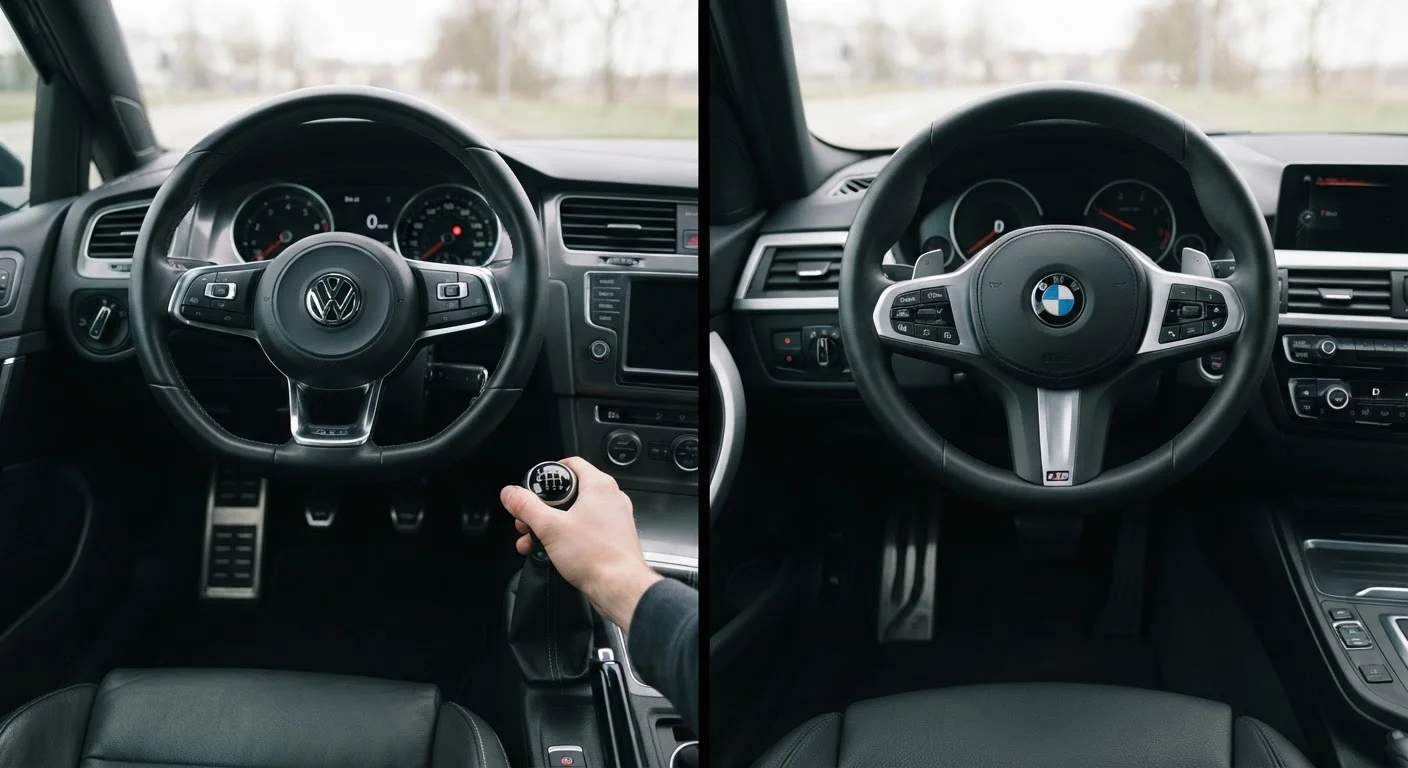
Key Takeaways
Option A
Manual Transmission
The hands-on, skill-building classic.
Best for: Learners who want full control over the vehicle and plan to drive a wide variety of cars long-term.
Option B
Automatic Transmission
The streamlined, lower-barrier entry to driving.
Best for: Beginners who want to focus on road awareness first and reduce the mental load of learning to drive.
If you feel anxious behind the wheel and want to simplify the learning process
Automatic Transmission
Removing clutch control and gear selection from the equation lets you concentrate fully on road positioning, observation, and hazard awareness - the skills that matter most early on.
If you want the broadest possible driving flexibility for the future
Manual Transmission
A manual licence allows you to legally drive both manual and automatic vehicles, which matters if you travel, rent cars, or may need to drive a variety of vehicles for work.
If you live or learn primarily in a busy urban area with heavy stop-start traffic
Automatic Transmission
Constant clutch engagement in slow-moving city traffic is one of the most physically tiring aspects of manual driving and a common source of stalling for new drivers.
If you plan to drive enthusiastically on varied roads including motorways and rural routes
Manual Transmission
Understanding how gear choice affects acceleration, braking, and engine braking gives you a more intuitive feel for vehicle behaviour across different driving conditions.
What the Two Transmissions Actually Ask of You
Before choosing which to learn on, it helps to understand what each transmission physically and mentally demands from a new driver.
A manual transmission requires you to coordinate three inputs simultaneously: the clutch pedal (which temporarily disconnects the engine from the wheels), the accelerator, and the gear lever. Getting this coordination wrong - especially on a hill - can cause the car to stall, lurch, or roll backward. This is the main source of anxiety for new manual learners. However, that challenge also means you build a tactile understanding of how the engine's power reaches the wheels.
An automatic transmission handles gear changes for you. There is no clutch pedal. You select Drive, and the car manages the rest. This significantly reduces the physical and cognitive demand during early lessons, freeing your attention for observation, road positioning, and anticipating hazards - which are arguably the most critical beginner skills.
Part of building genuine driving confidence is matching your learning environment to your current capacity. Overloading a beginner with too many simultaneous tasks can slow progress and reinforce anxiety rather than resolve it.
The Real Trade-Offs: Flexibility vs Simplicity
The most important practical consideration is licence scope. In the United States, both manual and automatic drivers hold the same standard licence - meaning you can legally drive either type regardless of which you learned on. However, comfort and actual ability are different from legal permission. A driver who has only ever practised on an automatic may struggle significantly the first time they sit behind a manual gearbox without proper training.
| Criterion | Manual Transmission | Automatic Transmission |
|---|---|---|
| Physical demand | High - clutch, gear, accelerator coordination | Low - no clutch pedal required |
| Mental load for beginners | Higher initially | Lower - more focus on road awareness |
| Vehicle flexibility | Can drive both types with practice | Comfortable primarily in automatics |
| Common in US market | Less common in new vehicles | Dominant in US new car market |
| Mechanical understanding gained | Deeper engine and gear awareness | Less direct mechanical feedback |
| Urban stop-start traffic | Tiring and stall-prone for beginners | Much easier to manage |
| Typical learning curve | Longer before smooth competence | Faster to basic road-ready stage |
Learning on a manual provides a transferable skill set. Understanding clutch bite points, engine braking (using the engine's resistance to slow the car rather than relying solely on brakes), and gear selection for different speeds gives you tools you can apply even in an automatic - for example, knowing when to select a lower gear on a steep descent.
Learning on an automatic, by contrast, gets you road-ready faster for the specific vehicles most common in the US market, where automatics dominate. If the car you'll primarily drive is automatic - which is likely for most US drivers - starting there is entirely logical.
Early habits are surprisingly hard to shake, so whichever transmission you start with, make sure you're learning correct technique from the beginning rather than developing workarounds.
Building Long-Term Confidence: What the Research Suggests
Driver confidence is shaped less by transmission type and more by the quality and quantity of practice. Consistent exposure to varied road conditions - residential streets, dual carriageways, night driving, adverse weather - builds the pattern recognition that makes driving feel natural over time.
That said, there is a reasonable argument that manual training develops a more nuanced mechanical awareness. Drivers who have learned to manage a clutch often report a stronger sense of car control because they have had to actively manage the relationship between engine speed and road speed. This understanding can be genuinely useful in low-traction situations, such as driving on wet or icy roads.
Automatic learners, on the other hand, often develop stronger observation habits earlier, simply because they have more mental bandwidth available during lessons. They are not managing clutch anxiety - they are watching junctions, reading road signs, and building spatial awareness.
Both paths lead to competent drivers when supported by good instruction. The question is not which transmission is objectively easier, but which allows you to learn most effectively given your circumstances. Once you have your licence, progressing to more demanding driving scenarios - such as motorway driving for the first time - will feel far more manageable with a solid foundation in place, regardless of transmission type.