

Key Takeaways
Significantly lower upfront cost
Flat pack cabinets can cost 50-70% less than comparable custom work, making them accessible for homeowners with tighter renovation budgets.
Widely available and quick to obtain
Most flat pack lines are in stock and can be ready within days, allowing renovation timelines to stay short and flexible.
Replaceable individual components
If a door gets damaged years later, you can often order a replacement panel rather than replacing an entire cabinet run.
DIY-friendly assembly process
Most flat pack systems are designed for assembly with basic tools and clear instructions, making them manageable for motivated beginners.
Limited sizing flexibility
Standard size increments mean gaps and filler strips are common in kitchens that don't conform to the usual 3-inch width intervals.
Variable build quality across price tiers
Lower-cost flat pack lines often use particleboard rather than plywood and include hardware that wears faster under daily use.
Labor-intensive DIY installation
A full kitchen installation typically takes multiple days and requires leveling, fastening to studs, and precise alignment - errors can be hard to correct.
Longer lead times for custom orders
Custom cabinets generally require six to twelve weeks from order to delivery, which can delay countertop installation and the rest of a renovation schedule.
Higher cost may not always be recouped
In lower price-point homes or short-term ownership scenarios, the premium paid for custom cabinetry may not be recovered at resale.
Our Verdict
Flat pack cabinetry is a practical, budget-conscious solution for standard kitchen layouts where a homeowner has time to assemble and some comfort with basic tools. Custom cabinetry justifies its premium when your space has unusual dimensions, you have specific material requirements, or you're making a long-term investment in a high-use kitchen. Neither choice is inherently superior - they serve different homeowners at different life stages.
Flat pack suits budget-focused homeowners with standard spaces and DIY confidence; custom suits those prioritizing longevity, precise fit, and design control.
What "Flat Pack" and "Custom" Actually Mean
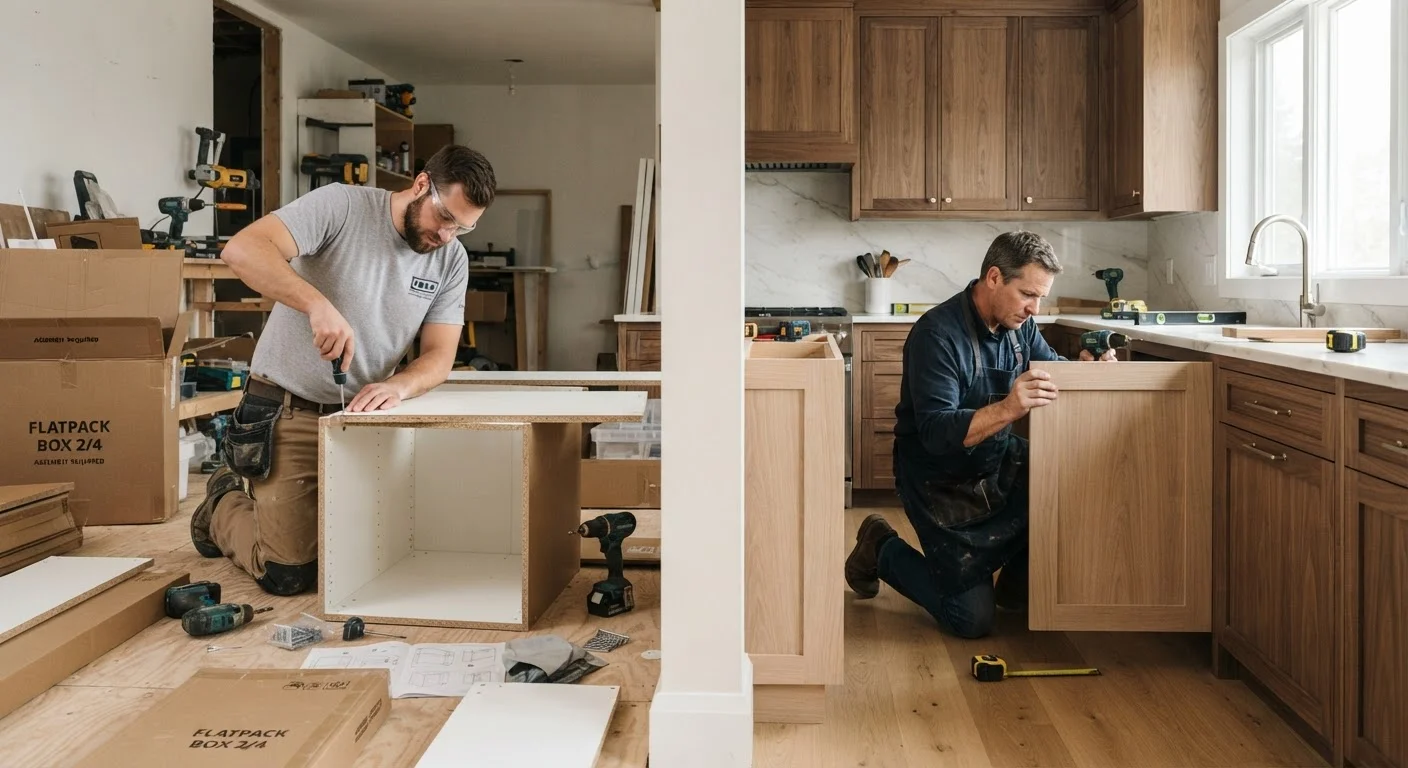
Before weighing trade-offs, it helps to understand exactly what you're comparing. Flat pack cabinets - sometimes called ready-to-assemble (RTA) cabinets - arrive in boxes as pre-cut panels, hardware, and instructions. You assemble them at home, often without specialized tools. They're manufactured in standard sizes and sold through home improvement stores or online retailers.
Custom cabinetry is built to order by a cabinetmaker or cabinet shop. Dimensions, wood species, finish, interior fittings, and door styles are all specified by you (often with the help of a designer). The shop fabricates and typically installs them. Semi-custom cabinets sit in between: they use standard cabinet boxes but allow more finish and size flexibility than fully flat pack options.
This article focuses on the two ends of that spectrum, since that's where the trade-offs are sharpest. If you're also weighing how storage decisions affect your overall kitchen layout, open shelving vs. closed cabinets is worth reading alongside this guide.
The Case for Flat Pack: Pros and Real-World Limits
The most obvious appeal of flat pack cabinets is cost. Depending on kitchen size and cabinet line, you can spend a fraction of what custom work commands. That gap is real and significant for most homeowners working within a renovation budget.
Significantly lower upfront cost
Flat pack cabinets can cost 50-70% less than comparable custom work, making them accessible for homeowners with tighter renovation budgets.
Widely available and quick to obtain
Most flat pack lines are in stock and can be ready within days, allowing renovation timelines to stay short and flexible.
Replaceable individual components
If a door gets damaged years later, you can often order a replacement panel rather than replacing an entire cabinet run.
DIY-friendly assembly process
Most flat pack systems are designed for assembly with basic tools and clear instructions, making them manageable for motivated beginners.
The limits, however, are equally real. Standard cabinet sizes come in fixed increments - typically 3-inch width jumps. If your kitchen has an awkward alcove, a sloped ceiling, or non-standard wall spacing, you'll end up with filler strips and visible gaps that require extra work to address. Assembly quality also depends on the assembler: poorly joined cabinets can rack (lean out of square) over time, affecting door alignment and drawer operation.
Hardware quality in lower-priced flat pack lines is often where corners are cut. Soft-close hinges and full-extension drawer slides add cost but meaningfully improve daily usability - check what's included versus what costs extra before you compare prices across lines.
The Case for Custom: Pros and Real-World Limits
Custom cabinetry's core advantage is fit - in every sense. A cabinetmaker can work to the exact inch of your space, eliminating fillers and awkward gaps. You also choose materials: plywood versus particleboard box construction, face frame versus frameless style, and any wood species or finish you want.
Limited sizing flexibility
Standard size increments mean gaps and filler strips are common in kitchens that don't conform to the usual 3-inch width intervals.
Variable build quality across price tiers
Lower-cost flat pack lines often use particleboard rather than plywood and include hardware that wears faster under daily use.
Labor-intensive DIY installation
A full kitchen installation typically takes multiple days and requires leveling, fastening to studs, and precise alignment - errors can be hard to correct.
Longer lead times for custom orders
Custom cabinets generally require six to twelve weeks from order to delivery, which can delay countertop installation and the rest of a renovation schedule.
Higher cost may not always be recouped
In lower price-point homes or short-term ownership scenarios, the premium paid for custom cabinetry may not be recovered at resale.
The practical downside begins with lead time. Custom cabinets typically take six to twelve weeks from order to delivery, sometimes longer depending on the shop's backlog. That affects your entire renovation schedule - countertop templating, appliance delivery, and finish work all follow cabinet installation.
Cost is the other significant barrier. Custom kitchens can run two to four times the price of comparable flat pack installations, and that gap widens with premium materials. The investment may be justified in a home you plan to stay in long-term, but it's harder to recoup in a shorter-horizon ownership scenario. Always get itemized quotes and understand what's included in installation.
Semi-Custom Cabinets: A Middle Path
Semi-custom cabinets use standardized box construction but allow modifications to height, depth, and finish options that fully flat pack lines don't offer. Lead times run shorter than true custom - typically two to four weeks - and costs fall between the two extremes. For kitchens that need minor size adjustments but don't justify the full custom premium, semi-custom is worth pricing out alongside both options.
Installation: What Each Route Actually Demands
Flat pack installation is a genuine DIY project - but it's not a casual weekend task. A full kitchen typically requires leveling base cabinets across an imperfect floor, securing wall cabinets to studs, cutting toe kicks, and aligning doors and drawer fronts. Plan for two to three full days minimum for a moderate kitchen, more if you're new to the process. Mistakes during assembly (stripping cam locks, misaligning panels) can be difficult to reverse.
Custom cabinet installation is usually handled by the shop or a contracted installer. This removes the labor burden from you but means coordinating schedules and ensuring your space is ready - walls patched, flooring decisions made, appliances confirmed. Make sure installation is explicitly included in your quote; some shops price it separately.
In both cases, any work involving electrical, plumbing, or load-bearing walls that gets disturbed during a kitchen remodel should be handled by licensed professionals. Permits may be required depending on your municipality and the scope of work - verify local requirements before starting.
How to Decide: A Practical Framework
Rather than defaulting to cost alone, run through a few concrete questions before committing.
- Does your space have non-standard dimensions? If yes, custom or semi-custom will save headaches that flat pack filler strips can't fully solve.
- What's your realistic timeline? If you need a functioning kitchen in six weeks, flat pack wins by default. Custom simply takes longer.
- How long do you plan to stay in the home? Longer ownership horizons make higher upfront investment easier to justify.
- Are you comfortable with assembly and installation? Flat pack DIY done poorly can cost more in repairs than hiring out custom installation from the start.
- What's the kitchen's role in your home's value? In higher price-point homes, kitchen quality is heavily scrutinized by buyers. In starter homes, over-investing in cabinetry may not be recovered at sale.
There's no shortcut that makes this decision universal. Both paths can produce a kitchen you love - the one that works depends on your specific constraints, not a general ranking.
50-70%
Typical cost savings with flat pack vs. custom
Industry estimates consistently show flat pack cabinetry running at roughly half to one-third the cost of equivalent custom installations, though this varies by region and material choices.
6-12 weeks
Typical lead time for custom cabinet orders
Most custom cabinet shops require six to twelve weeks from finalized order to delivery, a timeline that affects every downstream step in a kitchen renovation.