

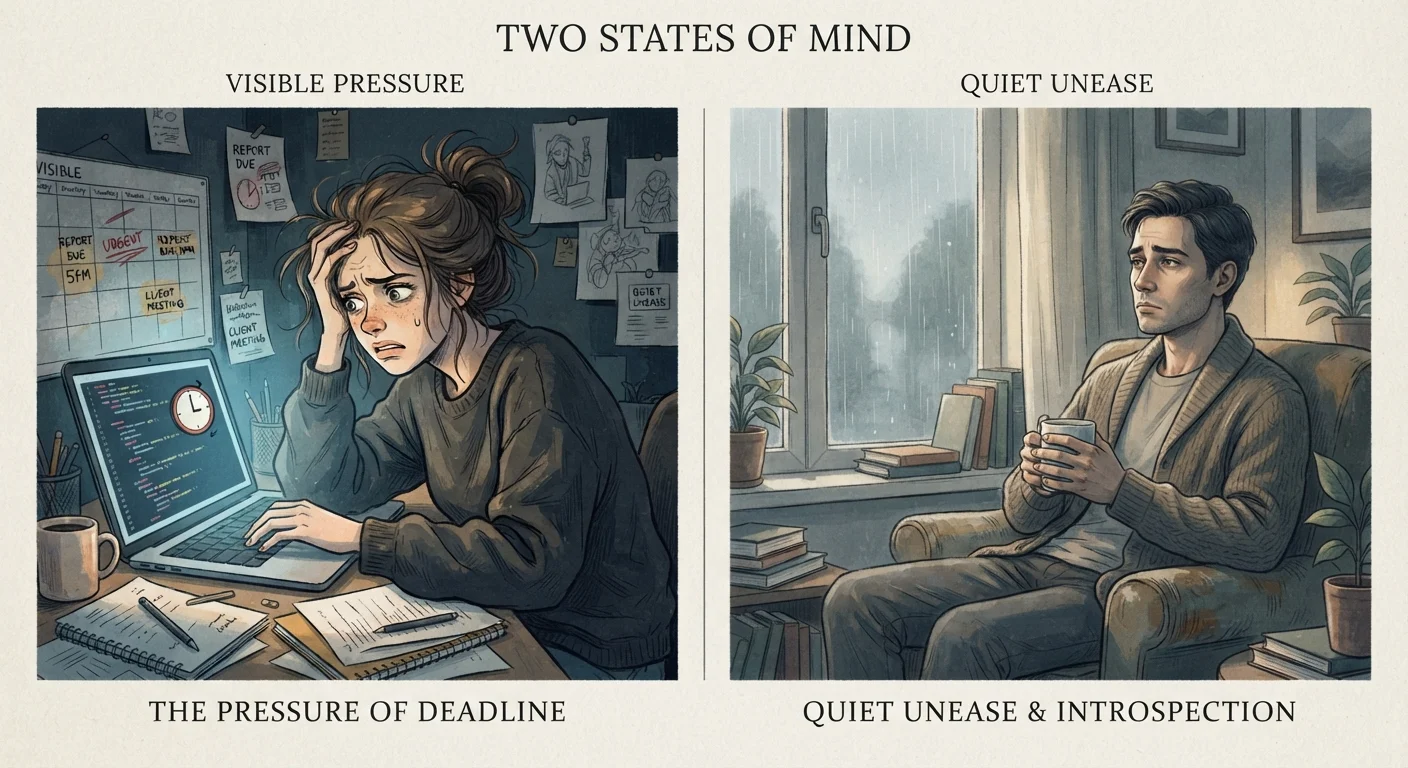
Key Takeaways
Option A
Stress
The body's response to an identifiable external pressure.
Best for: Understanding reactions tied to specific, real-world demands like work deadlines, conflict, or financial pressure.
Option B
Anxiety
Worry that persists even without a clear external trigger.
Best for: Recognizing internal, forward-looking dread that lingers after a stressor is resolved or exists without one.
If your distress clearly links to a specific deadline, conflict, or life event
Stress
What you're feeling is likely stress - it should ease once the situation resolves. Problem-solving and short-term coping tools tend to help most.
If worry lingers long after a problem is solved or appears with no clear cause
Anxiety
This pattern points more toward anxiety. Grounding techniques and professional support are worth exploring sooner rather than later.
If you're unsure which applies to you and symptoms are interfering with daily life
Anxiety
When distress feels uncontrollable or disproportionate to what's happening around you, treating it as anxiety and consulting a professional is the safer starting point.
What Stress Actually Is
Stress is your body's response to a demand it perceives as exceeding your current resources. That demand is almost always identifiable: a pile of work tasks, an argument with a partner, a car repair bill you weren't expecting. The key feature of stress is that it has a recognizable external source.
Physiologically, stress activates the body's fight-or-flight response - releasing hormones like cortisol and adrenaline that raise your heart rate, tighten your muscles, and sharpen your focus. This reaction evolved to help us handle short-term threats, and it still works that way today. Once the stressor is resolved, those physical signals typically ease.
Stress can be short-lived (acute) or ongoing (chronic). Chronic stress - the kind tied to long-term pressures like caregiving or financial strain - is where health consequences begin to stack up. For a grounded look at how everyday stress affects your body and mind, see our guide to stress in daily health.
What Anxiety Actually Is
Anxiety shares many of stress's physical sensations - racing heart, shallow breathing, restlessness - but differs in one important way: it often doesn't require an external trigger. Anxiety tends to be forward-looking worry about things that may happen, could go wrong, or feel threatening even when nothing specific is causing the feeling right now.
Where stress typically eases when a situation resolves, anxiety can linger well after the event has passed or appear in the complete absence of any stressor. It often involves a loop of "what if" thinking that's hard to interrupt through practical action alone.
Anxiety exists on a spectrum. Mild anxiety is a normal human experience - it can sharpen attention before a big presentation. But when anxiety is frequent, intense, or begins limiting what you do day-to-day, it may indicate an anxiety disorder, which a mental health professional is best positioned to evaluate and support.
When Anxiety Needs Professional Support
Occasional anxiety is a normal part of life. However, if worry feels persistent, uncontrollable, or starts to affect your sleep, work, or relationships, it's worth reaching out to a mental health professional. Anxiety disorders are among the most common mental health conditions and respond well to evidence-based treatment. You don't need to meet a clinical threshold before seeking a conversation with your doctor or a therapist.
How to Tell the Difference in the Moment
Because the physical sensations overlap so heavily, stress and anxiety can feel identical while you're in them. A few questions can help you distinguish them:
- Is there a specific cause I can name? If yes, and the feeling tracks directly to that cause, stress is the more likely explanation.
- Does the worry disappear when the situation resolves? If your tension lifts once the deadline passes, that points toward stress. If it migrates to the next concern without relief, anxiety may be the better frame.
- Am I worrying about something that hasn't happened yet - or may never happen? Future-focused, hard-to-control worry is a hallmark of anxiety.
This distinction matters because it shapes what helps. Stress often responds well to practical problem-solving - breaking tasks into steps, asking for help, or removing the stressor. Anxiety tends to respond less to logic and more to techniques that calm the nervous system, like grounding exercises or mindfulness practices.
| Criterion | Stress | Anxiety |
|---|---|---|
| Primary cause | Identifiable external stressor | Internal worry, often without clear trigger |
| Duration | Eases when stressor resolves | Can persist after or without a stressor |
| Focus of concern | Present problem or demand | Future threat or "what if" scenarios |
| Physical symptoms | Tension, fatigue, rapid heartbeat | Similar, plus restlessness and ongoing unease |
| Helpful responses | Problem-solving, removing the stressor | Nervous system calming, mindfulness, professional support |
Building a Sustainable Response
Identifying which experience you're having is the first step - not a diagnosis, but a practical orientation. From there, small consistent habits often do more than dramatic interventions.
For stress, useful strategies typically include: prioritizing tasks rather than trying to manage everything at once, setting boundaries where possible, and building in short recovery periods throughout the day. For anxiety, practices that train attention - like mindfulness or meditation - can help interrupt the worry loop over time.
Both benefit from the basics: consistent sleep, regular movement, and social connection. These aren't clichés - they're well-supported buffers against both stress and anxiety at a physiological level.
If you find that anxiety is persistent, difficult to control, or getting in the way of your relationships or daily functioning, that's a signal to speak with a mental health professional. General information is a helpful starting point, but personalized support makes a meaningful difference.
This article is for general informational purposes only and is not a substitute for professional medical or mental health advice. If you are concerned about stress, anxiety, or your mental well-being, please consult a qualified healthcare or mental health professional.