

Key Takeaways
Option A
Chronological Resume
The standard, employer-trusted format.
Best for: Job seekers with a steady work history in a single field who want to show clear career progression.
Option B
Functional Resume
The skills-first alternative for non-linear paths.
Best for: Career changers, returners to the workforce, or those with employment gaps who want to lead with transferable skills.
If you have a consistent work history in one field
Chronological Resume
Employers and automated screening systems expect this format. It lets your career progression speak clearly without raising questions.
If you are switching careers or industries
Functional Resume
Leading with transferable skills rather than job titles helps recruiters see your relevance to a new field before getting distracted by unrelated roles.
If you have a significant gap in your employment history
Functional Resume
A skills-first structure lets you establish value upfront, though you should still be transparent about your timeline when asked.
If you are a mid-career professional with diverse experience
Chronological Resume
A well-structured chronological resume with a strong summary section can highlight range while still satisfying recruiter expectations.
If you are entering the workforce for the first time
Chronological Resume
Even with limited experience, a chronological format listing internships, coursework, and part-time work is what most entry-level hiring managers expect to see.
What Each Format Actually Does
A résumé format is not just a visual preference - it determines what information a hiring manager sees first and what story your application tells before they read a single word. Understanding the structural logic of each format helps you make a deliberate choice rather than defaulting to a template.
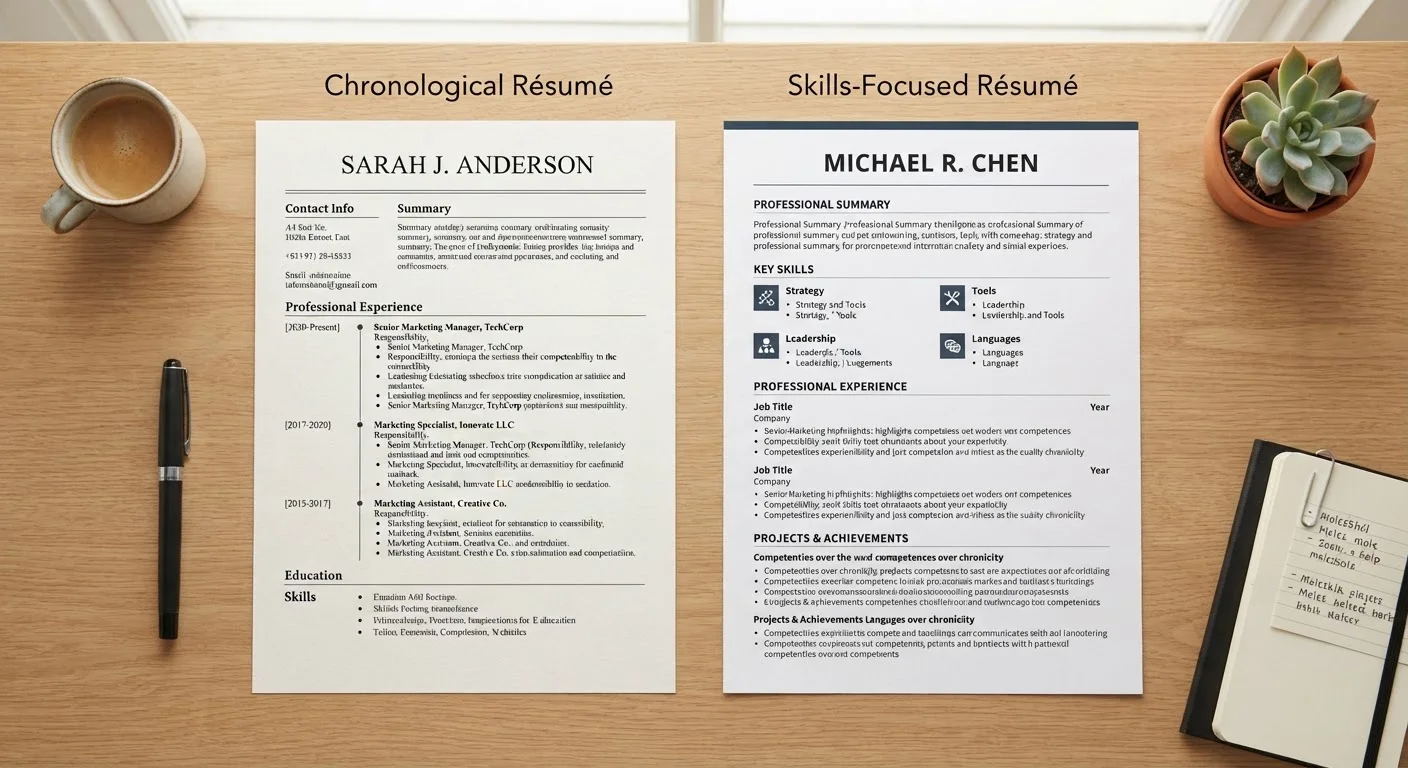
Chronological resumes list your work experience in reverse chronological order, starting with your most recent role and working backward. Each entry typically includes a job title, employer name, dates of employment, and bullet points describing your responsibilities and achievements. This structure makes your career trajectory immediately readable.
Functional resumes reorganize that same information around skill categories - for example, Project Management, Communication, or Technical Skills - and group accomplishments under those headings rather than under specific jobs. Employment history is still listed, but it is often condensed and pushed lower on the page.
For deeper guidance on what makes any résumé work once the format is settled, see Resume Writing That Actually Gets Read.
| Criterion | Chronological Resume | Functional Resume |
|---|---|---|
| Primary focus | Work history and job titles | Skills and competencies |
| Structure | Reverse time order | Skill category groupings |
| ATS compatibility | High - standard parsing format | Lower - non-standard layout may confuse systems |
| Recruiter reception | Widely trusted and expected | Can raise questions about work history |
| Best career stage | Entry-level through senior | Career changers, returners, non-linear paths |
| Handles employment gaps | Gaps are visible and may invite questions | Gaps are less prominent but not hidden |
| Shows career progression | Clearly - titles and promotions are explicit | Weakly - progression is not the focus |
Why Chronological Is the Default - and When to Use It
The chronological format dominates hiring for a simple reason: it is what most recruiters and applicant tracking systems (ATS) - the software that screens résumés before a human sees them - are built to read. ATS platforms parse job titles, employer names, and dates in predictable locations. A format that buries or rearranges that information may confuse the system or score poorly against keyword filters.
Beyond software, chronological ordering also builds trust. A recruiter scanning your résumé can see at a glance where you worked, for how long, and whether you advanced in responsibility. That transparency is reassuring, which is why most career advisors recommend it as the default unless you have a specific reason to deviate.
Use a chronological format if:
- Your work history is relatively continuous, without long unexplained gaps
- You are staying in the same field or industry
- Your job titles and employers are recognizable and relevant to the role you are applying for
- You are early in your career and want to show any experience you do have clearly
Even imperfect work histories - short stints, lateral moves, contract work - tend to read better in a chronological format than in a functional one that tries to hide them.
When a Functional Format Makes Sense
Functional resumes exist because some job seekers genuinely need to reframe their experience. If your job titles do not reflect the skills you actually developed, or if your career path has been interrupted or non-linear, a skills-first structure can help a hiring manager see your relevance faster.
That said, be aware of the trade-off: many recruiters are skeptical of functional formats precisely because they know the format is sometimes used to conceal gaps or unrelated experience. This skepticism means a functional résumé needs to be particularly compelling to overcome the initial hesitation.
Functional formats tend to work best when:
- You are making a significant career change and your skills transfer more than your job titles suggest
- You have an employment gap that would be the first thing noticed in a chronological format
- Your most relevant experience came from freelance, volunteer, or non-traditional work rather than traditional employment
The Combination Format: A Practical Middle Ground
A combination (or hybrid) résumé opens with a skills or summary section that highlights your most relevant competencies, then follows with a full chronological work history. This structure lets you frame your value upfront while still providing the transparency that recruiters and ATS systems expect. It is particularly well-suited to professionals switching industries or those with broad, varied experience that is difficult to capture in a purely chronological narrative.
A middle path worth considering is the combination (or hybrid) format, which opens with a skills summary section and then follows it with a full chronological work history. This lets you lead with relevance while still providing the transparency recruiters expect. Many career advisors consider this the most flexible option for mid-career professionals.
Understanding how your résumé will be received also depends on where you are submitting it. See Job Boards vs. Direct Company Applications for context on how application channels can influence what employers see.
Making the Right Call for Your Situation
Format choice is ultimately a strategic decision, not a stylistic one. Ask yourself what you most need a recruiter to notice first - your career progression, or your skill set - and choose accordingly. If you are uncertain, the chronological format is almost always the lower-risk choice.
Whichever structure you select, the content inside it still does the heavy lifting. Bullet points should lead with strong action verbs and quantify results wherever possible. Generic language like "responsible for" signals a weak résumé regardless of format. For a fuller picture of common mistakes job seekers make before they even get to the interview stage, see Things Job Seekers Get Wrong About the Hiring Process.
Career stage also matters. Your résumé priorities in your twenties are different from what they look like in your forties. Career Planning Across Every Decade explores how those shifts play out and what to emphasize at each phase.
The most common mistake is choosing a format based on what looks impressive rather than what communicates clearly. Clarity - for both human readers and automated systems - is always the goal.