
Career Planning Across Every Decade: What the Priorities Look Like at Each Stage

Key Takeaways
Why Career Planning Looks Different at Every Decade
A career isn't a single decision made once and maintained forever. It's a series of evolving priorities shaped by your skills, circumstances, financial needs, and the direction the labor market is moving. What makes sense at 24 - exploring roles, tolerating lower pay for learning opportunities - is rarely the right framework at 44, when leverage, leadership, and sustainability matter more.
Career planning is also frequently misunderstood. Many people treat it as something you do at a crisis point - when you're miserable, laid off, or stalled. In reality, the most useful planning happens in the stretches between crises, when you have time to think clearly. Understanding which questions deserve your attention at each life stage gives you a practical map rather than a vague directive to "figure out what you want."
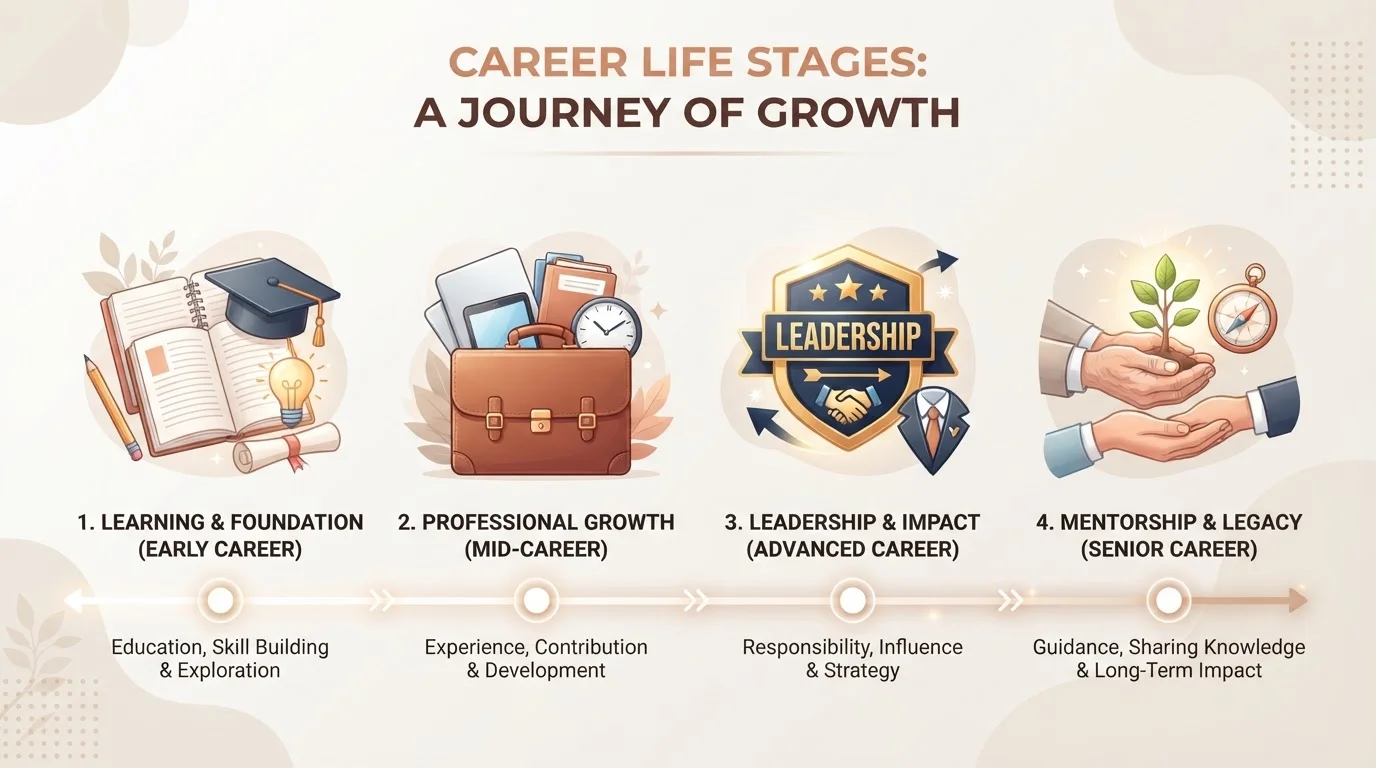
This guide breaks career planning into four broad decade-based phases. The ages are approximate - life doesn't follow a script - but the underlying priorities at each stage tend to hold up for most working adults. If you're mid-decade and feel behind or ahead, focus on the stage that reflects where you actually are, not where the calendar says you should be.
For a deeper look at how myths about career timing can create unnecessary anxiety, see common career planning myths that sound wise but often mislead.
Your Twenties: Building the Foundation
The central task of your twenties isn't finding your passion - it's building usable skills and understanding what you're actually good at. The most valuable thing you can do in this decade is accumulate diverse, honest feedback about your capabilities by putting them to work in real contexts.
Key priorities for this stage:
- Skill breadth over depth: Early on, exposure matters more than specialization. Try adjacent roles, take on projects outside your job description, and pay attention to which types of problems energize you.
- Building a professional network intentionally: Relationships formed early in a career often turn into collaborators, references, and mentors decades later. Invest in these connections before you need them.
- Learning financial basics: Understanding how compensation works - base salary, benefits, equity, retirement contributions - lets you negotiate better and avoid leaving value on the table.
- Tolerating strategic uncertainty: Committing too early to one narrow path can close off better options. Some ambiguity in your twenties is not a problem; it's often a feature.
In your twenties, ask for feedback in the form of specific examples, not general impressions. Phrases like 'Can you tell me about a moment when I handled something particularly well or poorly?' generate far more useful data than open-ended questions.
Behavioral specificity helps early-career professionals build accurate self-assessments, which form the foundation of all good career decision-making later on.
When evaluating a career move in your thirties or forties, assess the quality of the people you'd work with as heavily as the role itself - your professional growth is significantly shaped by who challenges and advocates for you daily.
Research on workplace learning consistently shows that peer and manager quality is among the strongest predictors of individual skill development and career advancement.
For a framework that helps you structure near-term moves without losing sight of where you're headed longer term, the article on balancing short-term and long-term career goals offers a practical approach.
Your Thirties: Deepening and Directing
By your thirties, the calculus shifts. You likely have enough experience to recognize where your comparative advantages lie - the things you do meaningfully better than most peers. This decade is the right time to start directing that advantage deliberately.
Key priorities for this stage:
- Choosing a direction and owning it: Specialization builds professional reputation and earning power. Continuing to generalize indefinitely can leave you undervalued relative to your experience level.
- Evaluating alignment between work and life: Relationships, caregiving responsibilities, health, and personal values often crystallize in your thirties. Career choices need to account for these, not compete with them.
- Building a track record, not just a résumé: At this stage, outcomes matter more than job titles. Quantifiable results - problems solved, teams led, revenue generated - become your primary currency.
- Identifying mentors and sponsors: A mentor gives advice; a sponsor advocates for you in rooms you're not in. Cultivating both relationships accelerates advancement in ways that individual effort alone cannot.
It's also worth tracking less obvious career milestones that signal genuine development beyond promotions and pay bumps.
Your Forties: Leading, Leveraging, and Reassessing
Midcareer is when planning often goes quiet - people feel they're past the exploration phase but not yet thinking about transition. That's a missed opportunity. Your forties can be among the most strategically important years of a working life, precisely because you have significant leverage: experience, credibility, and (often) financial breathing room to make deliberate choices.
Key priorities for this stage:
- Shifting from doing to leading: At senior levels, your value increasingly comes from enabling others - coaching, decision-making, and systems thinking rather than individual output.
- Reassessing fit honestly: If a role or organization no longer aligns with your values or growth needs, the cost of staying can be high. Midcareer pivots are more feasible than many people assume.
- Financial positioning: This is a critical window for building financial resilience - maximizing retirement contributions, reducing high-interest debt, and ensuring your compensation reflects your market value. Consult a licensed financial professional for decisions specific to your situation.
- Managing energy, not just time: Sustainability matters. High performers in their forties often credit deliberate recovery practices and clearer boundaries as much as any professional strategy.
If you're considering a significant direction change, the anatomy of a career pivot explains what a true pivot involves and how to think it through clearly.
Your Fifties and Beyond: Legacy, Flexibility, and the Long Game
Later-career planning carries its own distinct set of questions. How do you want to spend the most productive years of your expertise? What do you want to leave behind - in your organization, your field, or the people you've developed? And how do you stay professionally relevant while also preparing for what comes after full-time work?
Key priorities for this stage:
- Mentorship and knowledge transfer: Sharing what you know with less experienced colleagues is genuinely valuable - for them, for your organization, and for your own sense of purpose and continued engagement.
- Staying current deliberately: Skill obsolescence is a real risk, but it's preventable. Targeted upskilling in relevant areas - technology, new methodologies, evolving industry practices - keeps you competitive without requiring a full reinvention.
- Exploring flexible arrangements: Many professionals in their fifties find that consulting, part-time roles, or portfolio careers offer meaningful work with greater autonomy. These aren't fallbacks; they're legitimate strategic choices.
- Planning the transition clearly: Whether retirement is five years or fifteen years away, building a concrete plan for the financial and psychological dimensions of that shift is essential. A qualified financial adviser can help you model realistic scenarios.
The emotional dimensions of this stage are also worth attending to. Our related piece on mental well-being across life stages explores how emotional needs evolve and what supports them over time.
What Stays True Across Every Decade
Despite how much priorities shift, a handful of principles remain useful throughout a working life. First, planning works better when it's continuous rather than reactive - small, regular check-ins with your own direction outperform one-time overhauls triggered by crisis. Second, no career plan survives unchanged; the ability to adapt is itself a professional skill worth cultivating deliberately. Third, the non-obvious milestones - trust earned, skills developed, relationships built - matter as much as formal advancement, at every stage.
Finally, career planning doesn't happen in a vacuum. Work intersects with health, finances, relationships, and personal values at every decade, and the best planning accounts for the whole picture rather than optimizing for a single metric.
For a practical framework that holds up when circumstances change unexpectedly, see building a career strategy that holds up when plans change.