
Internal Family Systems vs. Inner Child Work: Two Paths to Self-Understanding

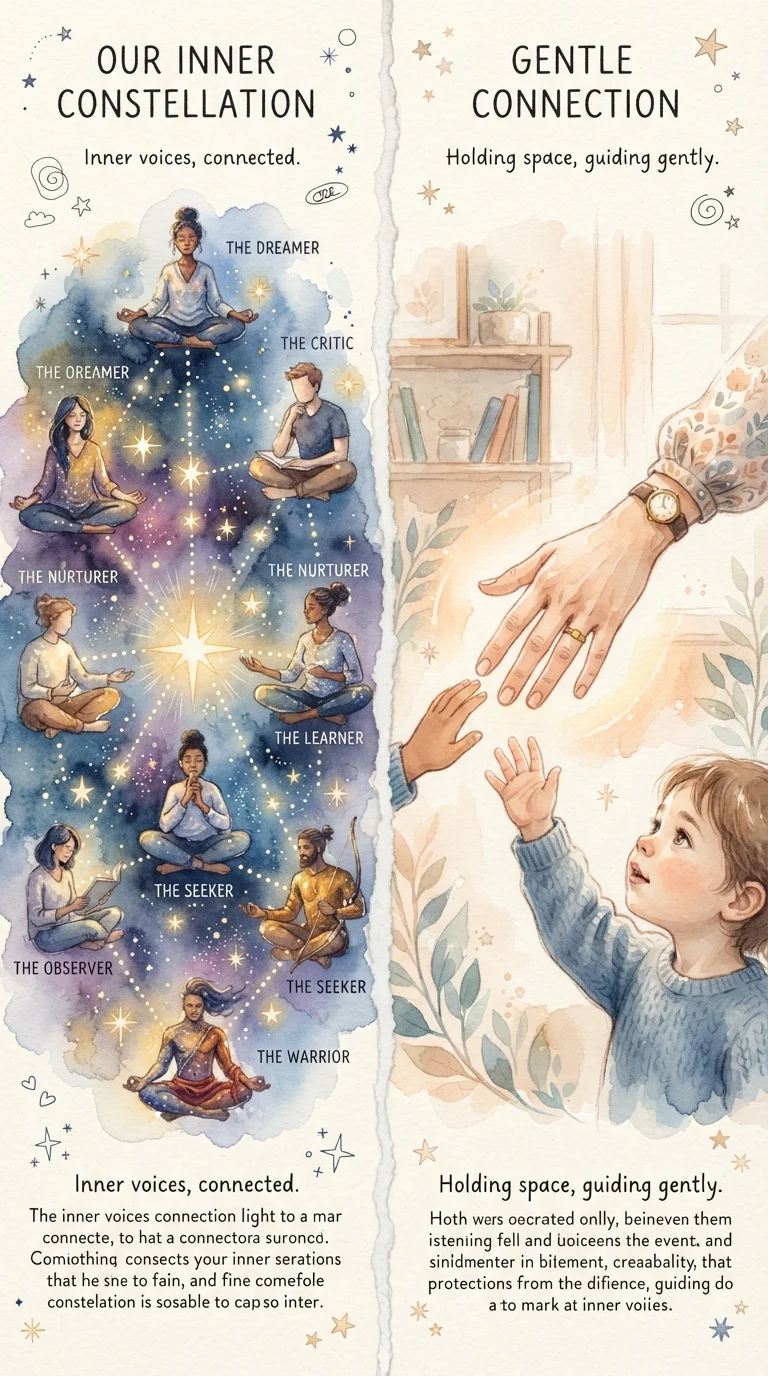
Key Takeaways
Option A
Internal Family Systems (IFS)
The structured, systems-based map of your inner world.
Best for: People who want a detailed framework for understanding the different, sometimes conflicting voices or impulses they experience within themselves.
Option B
Inner Child Work
The emotionally direct path back to your earliest self.
Best for: People drawn to exploring how childhood experiences and unmet needs continue to shape their adult feelings, reactions, and relationship patterns.
If you feel pulled in different directions and want to make sense of internal conflict
Internal Family Systems (IFS)
IFS offers a clear vocabulary for the competing impulses or 'voices' you experience, making it easier to observe your inner world without judgment.
If your relationship struggles seem rooted in childhood pain or unmet needs
Inner Child Work
Inner child work goes directly to the emotional source, helping you recognize and reparent the younger version of yourself still influencing your adult responses.
If you want a framework you can explore through writing and reflection outside therapy
Inner Child Work
Inner child exercises like letter-writing and visualization are widely used as self-guided tools, though professional support is still recommended for deeper wounds.
If you're already in therapy and want a model your therapist can actively guide
Internal Family Systems (IFS)
IFS is a formal therapeutic model with trained practitioners, making it well-suited to structured clinical work with a qualified professional.
What Each Approach Actually Involves
Both Internal Family Systems (IFS) and Inner Child Work are methods for exploring the psychological patterns that shape how you feel, behave, and connect with others. While they share an emphasis on self-compassion and looking inward, their frameworks are quite different.
IFS, developed by psychotherapist Richard Schwartz, proposes that the mind is naturally made up of multiple distinct 'parts.' These aren't disorders - they're normal features of human psychology. Some parts act as protectors (keeping painful emotions at bay through distraction, perfectionism, or anger), while others carry the emotional burden of past hurts. At the center of IFS is the concept of the 'Self' - a calm, curious, compassionate core that can learn to lead the whole system. Therapy and self-reflection using IFS involve identifying these parts, understanding their roles, and building a more trusting relationship among them.
Inner Child Work is less a single formal model and more a broad therapeutic concept, drawing on ideas from developmental psychology and trauma-informed care. The premise is that experiences from childhood - particularly unmet needs, neglect, or emotional wounds - live on as an 'inner child' influencing adult behavior. The work involves revisiting and acknowledging those early experiences, grieving what was missing, and learning to offer yourself the care and validation you needed then. Techniques often include guided visualization, letter-writing, and dialogue exercises. For a plain-language guide to terms you'll encounter in both approaches, see our glossary of self-awareness terms.
| Criterion | Internal Family Systems (IFS) | Inner Child Work |
|---|---|---|
| Core concept | The psyche as a system of 'parts' | Wounded younger self influencing adulthood |
| Formal therapeutic model | Yes - developed by Richard Schwartz | No - a broad therapeutic concept |
| Key goal | Harmony among parts, led by the Self | Healing and reparenting early wounds |
| Primary techniques | Part-mapping, dialogue, unburdening | Visualization, letter-writing, grieving |
| Best explored with | A trained IFS therapist | A therapist or guided self-reflection |
| Language and tone | Systematic, curious, non-pathologizing | Emotional, relational, nurturing |
| Focus on childhood | Indirect - parts often carry childhood pain | Direct and central |
How Each Approach Connects to Your Relationships
Self-understanding isn't a solo project - it directly affects how you show up with others. Both IFS and Inner Child Work are particularly relevant if you notice recurring patterns in your relationships: pulling away when someone gets close, people-pleasing to avoid conflict, or reacting with an intensity that surprises even you.
Through an IFS lens, those patterns often reflect a protective 'part' doing its job - perhaps a part that learned long ago that vulnerability led to hurt. Getting to know that part with curiosity rather than shame can gradually shift how you respond in real time. Inner Child Work frames similar dynamics as the wounded younger self seeking what it never received: safety, validation, consistent love. Both perspectives treat these patterns as understandable responses, not character flaws.
It's worth noting that self-exploration has limits. As our article on when personal growth becomes a way to avoid real connection explores, inner work is most valuable when it opens you up to others - not when it becomes a reason to wait indefinitely before letting anyone in.
Practical Ways to Explore Each Approach
You don't have to be in formal therapy to begin engaging with either framework, though professional guidance - particularly for significant emotional wounds - is strongly recommended. Both approaches can also complement work you're already doing with a licensed therapist or counselor.
For IFS, a starting point is simply noticing when you feel pulled between competing impulses - the part that wants to reach out and the part that says 'don't bother.' Instead of trying to silence either voice, practice getting curious: What is this part trying to protect me from? IFS-informed books and workbooks exist, but the model is best navigated with a trained IFS therapist for deeper work.
For Inner Child Work, structured journalling is a commonly used entry point - writing as your adult self to your younger self, or exploring what a specific age of you most needed to hear. Our piece on journalling for self-discovery covers methods like dialogue writing and unsent letters that translate naturally to inner child exploration.
Whichever path draws you, the goal is the same: building enough self-knowledge to show up in your relationships with more awareness and less reactivity. If you're weighing whether to pursue this through therapy or self-guided tools, our guide on therapy vs. self-help offers a clear-eyed look at what each genuinely offers.
This article is for general informational and educational purposes only and does not constitute professional mental health or therapeutic advice. If you are experiencing significant emotional distress or trauma, please seek support from a qualified mental health professional.