

Key Takeaways
Budget
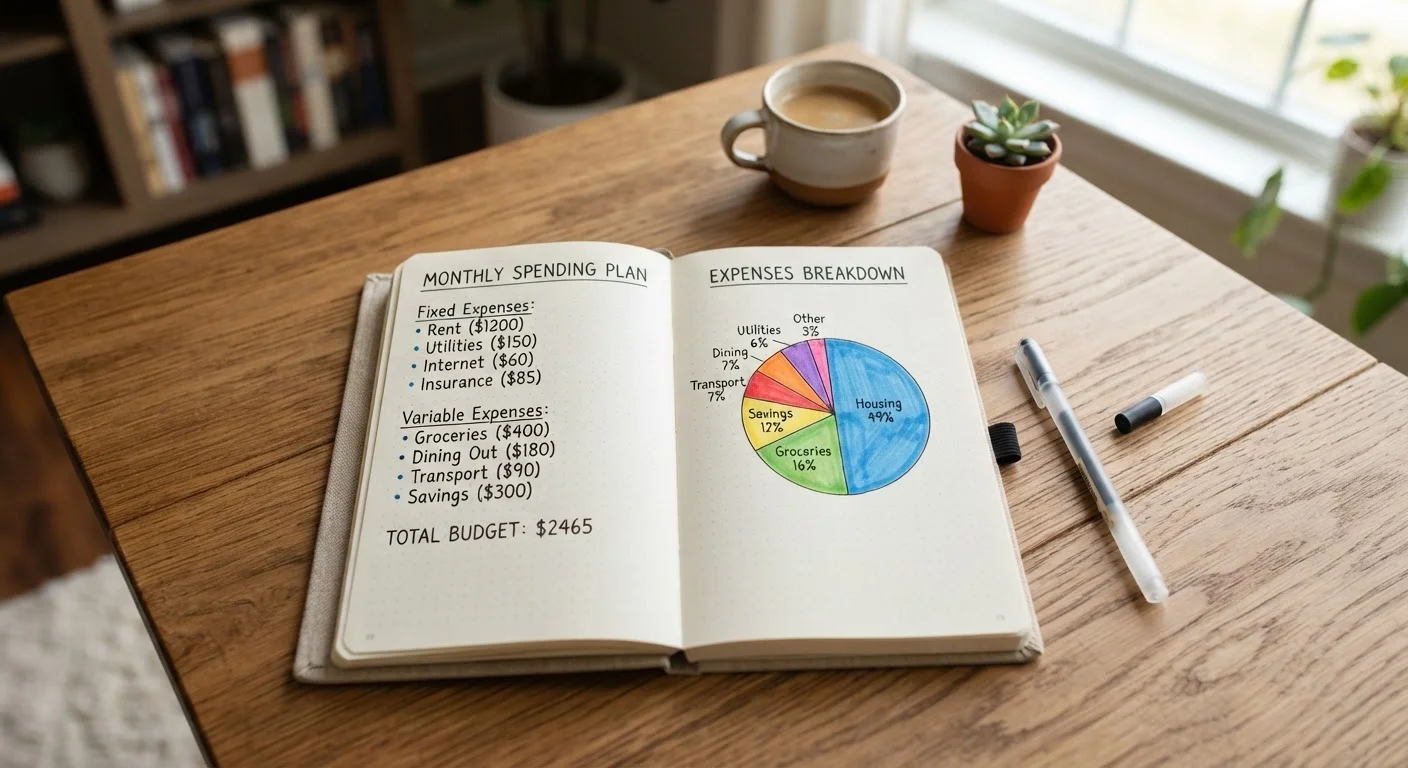
A budget is a written plan that tells your money where to go before the month begins. It lists what you expect to earn (your income) and decides in advance how much you'll spend, save, and set aside for different purposes. Think of it as giving every dollar a job description.
In personal finance, a budget is distinct from a financial statement: it is forward-looking (a plan) rather than backward-looking (a record of what already happened).
The Misconception That Makes Budgeting Feel Like a Punishment
Ask someone how they feel about budgets, and a familiar picture emerges: restriction, sacrifice, a ledger full of things you're no longer allowed to enjoy. That framing is the single biggest reason most people resist making one.
A budget is not a list of prohibitions. It is a spending plan - a document you create that decides, in advance, where your money will go. You are the one writing the plan. You choose the categories, the amounts, and the priorities. Nothing is off-limits by definition; everything is a deliberate allocation.
The misunderstanding runs deep because many people first encounter the word "budget" when someone else imposes one on them - a parent, an employer cutting costs, a government reducing services. In those contexts, budgets do mean cuts. Applied to personal finance, the power dynamic is completely reversed: you are in charge of the plan.
Reframe the Word Before You Start
Before creating your first budget, try replacing the word 'budget' with 'spending plan' in your mind. It sounds minor, but the shift from 'restriction' to 'plan' changes how you approach the exercise. You're not cutting things out - you're deciding, on purpose, what matters most to you.
What a Budget Actually Contains
Strip away any complicated system or app, and a personal budget has two sides:
- Income: All money you expect to receive in a given period - your paycheck, freelance work, side income, or any other source.
- Expenses: Every category where that money goes - rent or mortgage, groceries, utilities, transportation, subscriptions, savings contributions, debt payments, and discretionary spending like dining or hobbies.
The goal is straightforward: your planned expenses should not exceed your income. When they do, the budget shows you exactly where to adjust. When there's money left, the budget helps you decide intentionally what to do with it - save more, pay down debt, or spend on something meaningful to you.
This is why a budget is sometimes described as "giving every dollar a job." Unplanned money tends to disappear without delivering much value; planned money tends to accomplish what you actually care about.
~1 in 3
US adults who follow a formal budget
Surveys by organizations such as the National Foundation for Credit Counseling have consistently found that a minority of American adults maintain a detailed household budget.
Under $1,000
Emergency savings held by many US households
Federal Reserve research on household economics has repeatedly found that a significant share of US adults would struggle to cover an unexpected $400 expense - underscoring why intentional saving through a budget matters.
Why Budgets Fail - and Why That's Not a Character Flaw
Most people who have tried and abandoned a budget blame themselves. In reality, the failure is almost always structural, not personal. Common culprits include:
- Perfectionistic goals: Setting spending targets so tight that one unexpected expense blows up the whole plan.
- Irregular expenses ignored: Forgetting about annual costs - car registration, insurance premiums, holiday gifts - that don't show up every month but are entirely predictable.
- No review habit: Treating the budget as a one-time document rather than a living tool to check and update regularly.
Understanding why budgets break down is just as important as building one. For a closer look at the structural reasons plans fall apart, see why budgets fall apart after week one. And if you've ever told yourself you don't earn enough to bother, that belief is worth examining - it's one of the most common reasons people delay getting started.
Choosing a Framework That Actually Fits Your Life
There is no universally correct budgeting method. The right one is the one you will realistically maintain. A few widely recognized approaches:
- The 50/30/20 guideline
- Allocates roughly 50% of take-home pay to needs, 30% to wants, and 20% to savings and debt repayment. It's simple enough to understand in minutes and flexible enough to adapt.
- Zero-based budgeting
- Every dollar of income is assigned a category until the balance reaches zero. More detailed, but gives a precise picture of where everything goes.
- Envelope method
- Cash (or a digital equivalent) is divided into labeled envelopes for each spending category. When the envelope is empty, spending in that category stops for the month.
Each method has trade-offs in complexity and flexibility. What they share is the same core function: they make your financial intentions explicit before the money is spent.
If you're ready to move from concept to action, building your first budget in seven steps is a practical place to start. For a broader foundation, this complete introduction to personal budgeting covers core concepts alongside realistic first steps.
This article is for general informational and educational purposes only and does not constitute personalized financial advice. Consider consulting a qualified financial professional for guidance specific to your situation.